Monday, December 2, 2013
Advent II A
2nd Sunday of Advent A
Readings: Isaiah 11:1‑10 Romans 15:4‑9 Matthew 3:1‑12
On the second Sunday of Advent the Church presents John the Baptist as Jesus' precursor, who "prepares the way of the Lord" by demanding that those who come to him reform their lives because “the kingdom of heaven is at hand.” We Christians still long for the fullness of God's reign of justice through Jesus the Messiah, and so we continue to pray in hope the refrain of this Sunday's responsorial psalm: "Justice shall flourish in his time, and fullness of peace forever" (Ps 72:7).
The opening reading is Isaiah's messianic vision of a future Davidic king who will be endowed with God's spirit and rule the land of Judah with justice. In contrast to the cowardly and self serving king Ahaz of Isaiah’s own time (see Isaiah 7‑8), this "shoot . . . from the stump of Jesse" will have the divine gifts of wisdom, understanding, counsel, strength, and fear of the Lord. Endowed with these virtues, he will both "judge the poor with justice" and "strike the ruthless with the rod of his mouth." As a result of his just rule, even the predatory violence in the animal world will be transformed into peaceful harmony.
Then the wolf shall be the quest of the lamb,
And the leopard shall lie down with the kid;
The calf and the young lion shall browse together,
With a little child to guide them. . . .
When the knowledge of the Lord fills the earth "as water covers the sea," the rule of this just king will be "as a signal for the nations" so that they too will "seek out his glorious dwelling."
Paul's prayer in the second reading is that the Jewish Christians and Gentile Christians in the Roman community "will think in harmony with one another." Although they have come to Christianity from very different religious traditions, Paul encourages them: "Welcome one another . . . as Christ welcomed you for the glory of God." Christ came to save and unify both groups. He "became the minister of the circumcised to show God’s truthfulness, to confirm the promises to the patriarchs," and his death on the cross is the source of "mercy" for the Gentiles. Christ's self-emptying love is to be the model for their treatment of one another.
Matthew's account of the ministry of John the Baptist presents him as the precursor of the Messiah who is beginning to gather a reformed people of God by calling everyone to repentance. First of all, Matthew carefully links John to figures from the Jewish Scriptures. He is "a voice of one crying out in the desert" spoken of in the Book of Isaiah. His camel's hair garment and wilderness diet recall the prophet Elijah who was expected to come at the end time to prepare God's people for the arrival of the kingdom (see 2 Kgs 1:8; Mal 3:1; 4:23‑24). John's fiery preaching challenges the Pharisees and Sadducees to produce true fruits of reform. Merely participating in his baptism or claiming to be descendants of Abraham will not suffice. John warns that “every tree that does not bear good fruit will be cut down and thrown in the fire.” His expectations for the Messiah are even more frightening. In contrast to his water baptism of repentance, “the mightier” one who will follow will baptize “with the Holy Spirit and fire.” Like a harvester with “his winnowing fan in his hand,” he will “gather his grain into the barn, but the chaff he will burn in unquenchable fire.”
As we consider what might be the proper fruits of repentance, we can do no better than the verses of this Sunday's responsorial psalm which pray that the future king will help bring about God's justice. We, like the king, are called to "save the poor when they cry/ and the needy who are helpless" and to "have pity on the weak/ and save the lives of the poor" (Ps 72:12‑13).
Monday, November 25, 2013
ADVENT I A

1st Sunday of Advent A
Readings: Isaiah 2:1-5 Romans 13:11-14 Matthew 24:37-44
In the Advent Season of preparation for the celebration of Christ’s Nativity each Gospel reading has a distinctive theme: the Lord’s coming at the end of time (First Sunday of Advent), the ministry of John the Baptist, the precursor of the Messiah (Second and Third Sundays), and the events that prepared immediately for the Lord’s birth (Fourth Sunday). The Old Testament readings are prophecies about the Messiah or the Messianic age, especially from the Book of Isaiah. The second readings from an apostolic letter contain exhortations and proclamations, in keeping with the themes of Advent: alertness in preparation for the coming of the Lord.
During the dark days of December, we Christians begin our Advent vigil by watching for the light and longing for the coming of God's kingdom of justice and peace in the Messiah Jesus. With our Jewish ancestors and the early Christian community, we are called to live in hope and eager expectation. As we listen to Isaiah's vision of peace for Judah and the city of Jerusalem, let us pray in the words of the responsorial psalm for peace in all the world's cities and nations.
Pray for the peace of Jerusalem!
May those who love you prosper!
May peace be within your walls,
prosperity in your buildings. (Ps 122:6‑7)
Although the prophet Isaiah lived through the Assyrian invasions which destroyed the kingdom of Israel and reduced Judah and Jerusalem to "a waste, like Sodom overthrown" (Is 1:9), his vision for the future is filled with hope for a world peace established by God. Isaiah envisions a time when "the mountain of the Lord's house shall be established as the highest mountain." Then the world's war weary nations will decide to pilgrimage to the Lord's temple mountain in Jerusalem in order to be instructed “in his ways." And the Lord "shall judge between the nations" so that they will turn their weapons into instruments of productive agriculture.
They shall beat their swords into plowshares
and their spears into pruning hooks;
one nation shall not raise the sword against another,
nor shall they train for war again.
Isaiah concludes with an invitation to the "house of Jacob" and to us: "let us walk in the light of the Lord."
Paul's exhortation to the Romans continues this Sunday's light theme and offers us a pattern for living in the season of Advent. Paul believed in the imminent return of the Lord Jesus to complete God's kingdom, and therefore he warns the Roman Christians: "the night is advanced, the day is at hand." He urges them "to wake from sleep" and "throw off deeds of darkness and put on the armor of light." They are to live honorably as in daylight and are to avoid carousing and drunkenness, sexual excess and lust, quarreling and jealousy.
The Gospel reading for the First Sunday of Advent is always from Jesus' apocalyptic sermons in Jerusalem just before his trial and death. In these sermons Jesus speaks of the destruction of the Jerusalem temple and his later triumphant return as the Son of Man to complete God's kingdom. During this year the Church does the A cycle of readings which feature Matthew's Gospel, and so this Sunday we read from his version of Jesus' apocalyptic discourse.
In this section Jesus warns his disciples that they cannot know the day the Lord is coming. Since the time is unknown, those who await Jesus' return must not make the mistake of the flood generation, when people were so totally unconcerned that “they were eating and drinking, marrying and being married, up to the day Noah entered the ark.” Because they were unprepared, “the flood came and carried them away.” Christians who live in the expectation of Jesus' coming cannot simply continue life as usual; they must “stay awake” and “be prepared” like the owner of a house who knows a thief is coming.
Perhaps, there is no better way to maintain this alertness than to live by the words that Isaiah puts on the lips of the nations in his vision.
"Come, let us climb the Lord's mountain,
To the house of the God of Jacob,
That he may instruct us in his ways,
And we may walk in his paths." (Isa 2:3)
Monday, November 18, 2013
Our Lord Jesus Christ, King of the Universe
34th Sunday in Ordinary Time: Christ the King C
Readings: 2 Samuel 5:1‑3 Colossians 1:1‑20 Luke 23:35‑43
The readings for this year's feast of Christ the King proclaim the paradox of Christian faith. Jesus, the rejected and crucified one, is also the triumphant Messiah who brings salvation "through the blood of his cross." A grateful joy, exemplified by the promise of Paradise to the penitent thief, marks the celebration. Let us enter the spirit of the feast in the refrain of the responsorial psalm (Ps 122): "I rejoiced when I heard them say: let us go to the house of the Lord."
The reading from Samuel is the joyful climax of a long process by which David rose from an insignificant shepherd boy to be king of both Judah and Israel (see 1 Samuel 16‑2 Samuel 5). After a bloody and tragic war between David's tribe of Judah and Israel under the leadership of Saul's descendants, the tribes of Israel finally decide to make David their king by coming to his Judean capital at Hebron. Their speech is both conciliatory and hopeful.
"Here we are, your bone and your flesh. In days
past, when Saul was our king, it was you who led
the Israelites out and brought them back. And
the Lord said to you, `You shall shepherd my people
Israel and shall be commander of Israel.'"
The elders anoint David and make a covenant with him in the hope that he will both "shepherd" Israel and bring them victory over their enemies as "commander" of the army.
The tone of joyful gratitude is continued in the thanksgiving from the letter to the Colossians. We Christians are to be grateful for the work of the Father who has "rescued us from the power of darkness and brought us into the kingdom of his beloved Son." This salvation has been brought about by Jesus through whom "we have redemption, the forgiveness of sins."
The main body of the reading is a great hymn celebrating the cosmic Christ as both the agent of creation and the savior who effected a second creation by "making peace through the blood of his cross." Paradoxically, Jesus is both "image of the invisible God, the first born of all creatures" and also "the first born from the dead" through his cross and resurrection. A fivefold repetition of "everything" asserts Christ's cosmic power, but there is a wonderful incongruity in that the one in whom God's "absolute fullness" resides has reconciled the world as a crucified king.
He is the image of the invisible God, the first born of all creatures.
In him everything in heaven and on earth was created . . .
All were created through him, and for him.
He is before all else that is. In him everything continues in being.
It is he who is head of the body, the church;
he who is the beginning, the first-born of the dead,
so that primacy may be his in everything.
It pleased God to make absolute fullness reside in him and,
by means of him to reconcile everything in his person,
everything, I say, both on earth and in the heavens,
making peace through the blood of his cross.
Luke's crucifixion scene exemplifies the divided response that accompanied Jesus throughout his ministry in this gospel. As the innocent, suffering Messiah (see Ps 22:7‑8, Wis 2:18; Ps 69:21), Jesus reigns from the cross and continues to extend the offer of God's mercy to sinners. The people are expectant; they stand there "watching." Later after witnessing the crucifixion, they will repent of their rejection of Jesus by "beating their breasts" (see Lk 23:13‑25, 48). Both "the leaders" and "the soldiers" give hostile, but ironically true, responses to Jesus. Like the devil in the desert (4:1‑13), they tempt Jesus to "save" his life by holding on to it (contrast 9:24). Ironically, only as the crucified one who dies in faith, can Jesus fulfill his destiny as “the Messiah of God” and “King of the Jews” (see 9:22; 18:33; 20:27‑40; 22:69; 24:26). The first thief also joins in the taunting, but the second, like so many sinners in the gospel, responds to Jesus with a deep faith. He believes that the dying Jesus is about to enter his Messianic reign and requests, “Jesus, remember me when you enter into your reign.” Jesus, as the new Adam who has been obedient and faithful (see Lk 4:1‑38) and who will experience God's victory over death, promises forgiveness to the repentant thief with the words, “I assure you: this day you will be with me in Paradise.”
Monday, November 11, 2013
33rd Sunday C
33rd Sunday in Ordinary Time C
Readings: Malachi 3:19‑20 2 Thessalonians 3:7‑12 Luke 21:2‑19
At the end of the Church year the liturgy focuses on our Christian hope for the coming of God's kingdom in the final judgment. This Sunday's readings call us to prepare for that judgment with lives of justice, fruitful work, and patient endurance. With fervent hope, we pray for the coming God's kingdom in the refrain for our responsorial psalm: "The Lord comes to rule the earth with justice" (Ps 98).
The prophecy in the Book of Malachi ("My messenger") is addressed to those who have lost faith in God's justice during the depressing years after Judah's return from exile (c. 450 B.C.). We hear of priests offering shoddy worship and neglecting their duty to instruct the people in Torah (Mal 1:6‑2:9). Many men have broken the marriage bond by divorcing their Jewish wives and marrying foreigners (2:10‑16). Finally, some, when they see the apparent prosperity of the wicked, have given up lives of justice and begun to ask “Where is the just God?” (Mal 2:17). In the midst of this moral malaise, the prophet proclaims that the fire of the Lord's justice will come. For the proud and wicked, it will be "blazing like an oven . . . leaving them neither root nor branch." But for those who fear the Lord, "there will arise the sun of justice with its healing rays."
We saw last week that 2 Thessalonians is written to a community confused by the belief that "the day of the Lord is already here" (2 Thess 2:2). Apparently, some equated this event with baptism and reasoned that, because they already enjoyed the benefits of salvation, they were free to live lives of disorder and idleness. Today's selection reminds the Thessalonians of how Paul and his co‑workers lived among them. Rather than being parasites on the community, they "worked day and night, laboring to the point of exhaustion so as not to impose on any of you." To prod the idle to resume productive lives, the author recalls Paul’s rule "that anyone who would not work should not eat." Last of all, the "busybodies" are enjoined "to earn the food they eat by working quietly."
The Gospel is taken from Luke's version of Jesus' apocalyptic sermon predicting the destruction of the Jerusalem temple and his coming as the Son of Man with power and glory. In Luke's account, Jesus makes a clear distinction between the fall of the temple and the events associated with “the end.” His followers are not to be misled by false messiahs who say, ‘I am he,’ or ‘The time is at hand.’ The wars and insurrections associated with the fall of Jerusalem to the Romans in 70 A.D. fired many with the expectation of Jesus' return, but in Luke Jesus warns: “These things are bound to happen first, but the end does not follow immediately.”
Jesus goes on to prepare his disciples for the trials they will experience before his final coming. As Luke recounts so dramatically in the Acts of the Apostles, Jesus' disciples can expect to be persecuted and summoned for trial in both synagogues and before kings and governors. When they are called upon to give witness to Jesus' name, he tells them not to worry, “for I will give you words and a wisdom which none of your adversaries can take exception to or contradict.” They can expect to be hated and may even die because of their witness to the gospel, but Jesus assures them “not a hair of your head will be harmed.”
Although Jesus' followers will be persecuted by the world's powers, they will have his assistance in time of trial and will experience the ultimate triumph of God's justice. For all of us who wait and struggle for the coming of God's kingdom, Jesus' final words are a source of hope: “By patient endurance you will save your lives.”
Monday, November 4, 2013
32nd Sunday Year C
![]() |
| Martyrdom of the Maccabees |
Readings: 2 Maccabees 7:1‑2,9‑14 2 Thessalonians 2:16‑3:5
Luke 20:27‑38
At the end of the liturgical year, the readings focus on the resurrection of those who have persevered in faith. As we hear of the heroic faith of Jesus in the Gospel and the seven Jewish martyrs in 2 Maccabees, let us join them in praying the refrain of this Sunday's responsorial psalm: "Lord, when your glory appears, my joy will be full" (Ps 17).
In the 2 Maccabees reading, the seven brothers die for their refusal to violate God's law during the terrible persecutions of Jews by Antiochus IV Epiphanes in the 160s B.C. Each gives a speech, expressing some aspect of resurrection faith. The first affirms courageous fidelity to God's law in the face of death: “We are ready to die rather than transgress the laws of our ancestors.” The second expresses a transcendent hope for a life beyond this physical life: “. . . you are depriving us of this present life, but the King of the world will raise us up to life again forever.” The third believes that God, who created life, can also restore it beyond death: “It was from Heaven that I received these (his bodily parts); for the sake of his laws I disdain them; from him I hope to receive them again.” Finally, the fourth brother states his hope that resurrection will be granted only for those who have been faithful: “It is my choice to die at the hands of men with the God-given hope of being restored to life by him; but for you, there will be no resurrection to life.”
The reading from Second Thessalonians also offers hope in the resurrection during a time of persecution and confusion. Because they were confused by the delay of Christ's triumphant return (see 2 Thes 2:1‑12), some Christians at Thessalonika were spreading the rumor that the Day of the Lord was at hand and were leading others into disorderly and irresponsible behavior (see 2 Thes 3:6‑16). In that context, the Pauline author prays that the community persevere in faith: "God our Father, who loved us and in his mercy gave us eternal consolation and hope, console your hearts and strengthen them for every good work and word." He also requests prayers for himself and his co‑workers as they struggle to be faithful to preaching the gospel.
Pray that we may be delivered from confused and evil men.
For not everyone has faith; the Lord, however, keeps faith;
he it is who will strengthen you and guard you against the evil one."
In today's Gospel Jesus, shortly before his own death, affirms his belief in resurrection against a challenge from Sadducees who claimed there was no resurrection. This hostile encounter occurs in the Jerusalem temple after Jesus has driven out the money changers and become embroiled in a heated controversy with the chief priests, scribes, and elders over his authority to be teaching in the temple (see Lk 19:45‑20:26). The Sadducees attempt to ridicule belief in resurrection by proposing a case from a law which was designed to keep property within the family (see Deuteronomy 25) by demanding that a woman marry her deceased husband’s brother. In their unlikely example a single woman married seven consecutive brothers in an attempt to raise posterity to the first brother (see also Tobit and Genesis 38). They want to know whose wife she will be at the resurrection.
Jesus' answer stands in the same tradition as the author of Second Maccabees. First, he asserts the radical transformation God will bring about “in the age to come.”
"The children of this age marry and are given in
marriage, but those judged worthy of a place in the
age to come and of resurrection from the dead do not.
They become like angels and are no longer liable
to death. Children of the resurrection, they are
children of God."
Then he goes on to prove this belief from a text in Exodus, a portion of the Torah that the Sadducees themselves accepted as authoritative.
"Moses in the passage about the bush showed that
the dead rise again when he called the Lord the
God of Abraham, and the God of Isaac, and
the God of Jacob."
Because these patriarchs had died centuries before the time of the revelation to Moses at the burning bush, Jesus can conclude that they must now be living with God because “God is not the God of the dead but of the living. All are alive for him.”
By limiting their hopes to worldly concerns about property and descent, the Sadducees demonstrate their lack of faith in God's power and the impoverished character of their own religious imaginations which are bound to these materialistic preoccupations.
Monday, October 28, 2013
31st Sunday in Ordinary Time C
Readings: Wisdom 11:22‑12:2 2 Thessalonians 1:11‑2:2 Luke 19:1‑ 10Today's readings emphasize God's mercy that continuously offers the possibility of repentance, even to those whom we, in our self righteousness, may deem unworthy of God's love. Let us praise the Lord's compassion in the words of our responsorial psalm: "I will praise your name forever, my King and my God!" (Ps 145).
The reading from the book of Wisdom is an apologia for God's loving providence. It is written in Greek and uses philosophical terminology that would make sense to its original audience: Jews living in Egypt during the first century B.C. God is the transcendent Lord before whom "the whole universe is as a grain from a balance/ or a drop of morning dew come down upon the earth" (Wis 11:22). But He is also the merciful one who "overlooks the sins of men that they may repent" (11:23). All that exists is potentially good and is sustained by God's love. “For you love all things that are/ and loathe nothing that you have made;/ for what you hated,/ you would not have fashioned” (11:24). God's love and compassion point to an eternal destiny that transcends this material order. “But you spare all things,/ because they are yours,/ O Lord, and lover of souls,/ for your imperishable spirit is in all things!” (11:26-12:1)
For the next three weeks the second reading will be from 2 Thessalonians, a letter which warns the Thessalonians not to be seduced into believing that the day of the Lord has arrived so that they no longer need to live responsible and ethical lives. Paul exhorts the Thessalonians: “we beg you, brothers and sisters, not to be so easily agitated or terrified, whether by an oracular utterance or rumor or letter alleged to be ours, into believing that the day of the Lord has arrived” (2 Thes 2:2). He urges them to endure their persecutions and trials in the assurance that God's justice will triumph over their persecutors. He prays that God will make them worthy of their calling so that God's name may be glorified in them. “We pray for you always that our God may make you worthy of his call, and fulfill by his power every honest intention and work of faith” (2 Thes 1:11).
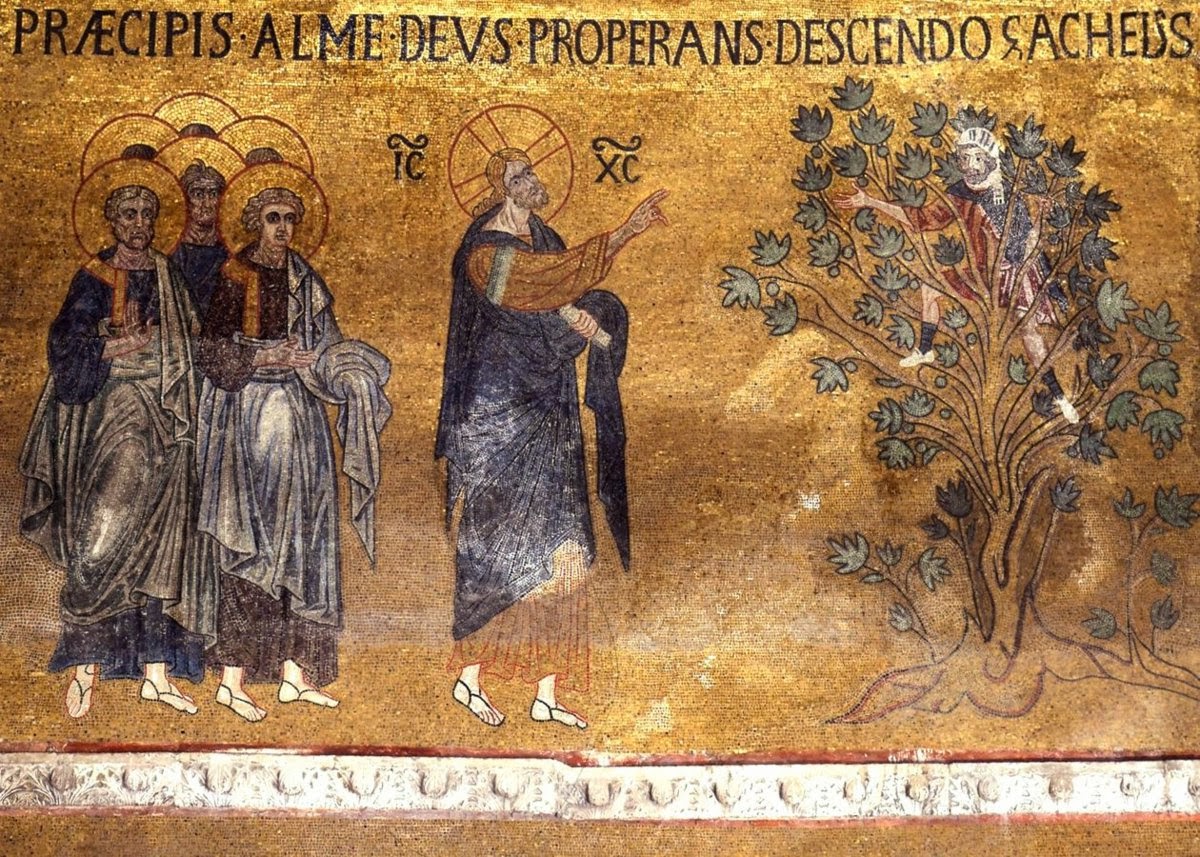
The Gospel presents the unforgettable story of Zacchaeus as an illustration of all that Christian repentance involves both for the penitent and for Jesus as the agent of God's salvation. As a tax collector and rich man, Zacchaeus represents the despised sinner in Luke's gospel because he had acquired his wealth through dishonest means. Yet this stereotypical sinner, like many others in Luke, is attracted to Jesus when he enters his town of Jericho, and he makes an extraordinary effort "to see what Jesus was like." Because he is "small of stature," Zacchaeus cannot see Jesus in the huge crowd so he climbs a sycamore tree. His efforts are matched by Jesus' outreach; he announces his intention to stay at Zacchaeus' house: “Zacchaeus, hurry down. I mean to stay at your house today.”
In contrast to the self righteous Simon the Pharisee earlier in Luke’s Gospel (see Luke 7:36‑50), Zacchaeus delightfully and hospitably welcomes Jesus. When everyone murmurs against Jesus' going to this sinner's house as a guest (see also Luke 15), Zacchaeus defends himself as a penitent. “I give half my belongings, Lord, to the poor. If I have defrauded anyone in the least, I pay him back fourfold.” Unlike the rich young man in the previous episode (Lk 18:18‑30), Zacchaeus knows that his possessions are to be used in charity for the poor, and that he is obligated by the law to make appropriate restitution to anyone he has overcharged in collecting taxes. The story concludes with Jesus affirming that Zacchaeus has discovered what it is to be a true child of Abraham. “Today salvation has come to this house, for this is what it means to be a child of Abraham. The Son of Man has come to search out and save what was lost.”
Monday, October 21, 2013
30th Sunday C
30th Sunday in Ordinary Time C
Readings: Sirach 35:12‑14,16‑18 2 Timothy 4:6‑8,16‑18
Luke 18:9‑14
Last Sunday's readings stressed the need for perseverance and faith in prayer. This week we learn that our prayer should seek justice and forgiveness in a spirit of humility. In the words of the responsorial psalm, let us pray:
When the just cry out, the Lord hears them,
and from all their distress he rescues them.
The Lord is close to the broken hearted;
and those who are crushed in spirit he saves. (Ps 34:18‑19)
Sirach's reflections assert that a desire for justice must accompany true worship. As a God of justice, the Lord does not favor the wealthy but "hears the cry of the oppressed," especially "the wail of the orphan" and "the widow's complaint." Therefore Sirach states that the one "who serves God willingly is heard," and "the prayer of the lowly pierces the clouds." The reading concludes with an act of faith in the final triumph of God's justice. "Nor will it (the prayer of the lowly) withdraw till the Most High responds,/ judges justly and affirms the right."
The closing portion of Second Timothy also binds a life of service to God's justice with worship. In language charged with emotion, the Pauline writer describes Paul’s suffering in prison and approaching death as "being poured out like a libation." Then, he depicts the struggle to be a faithful apostle in athletic imagery.
I have fought the good fight. I have finished the race,
I have kept the faith. From now on a merited crown
awaits me; on that day the Lord, just judge that he is,
will award it to me‑‑ and not only to me but to all
who have looked for his appearing with eager longing.
The author is not simply bragging in Paul’s name; he uses Paul’s situation to teach Timothy the proper attitude for a minister of the gospel in the midst of suffering and abandonment. Although Paul had no one to defend him in his first hearing before the Roman court, he forgave those who abandoned him in time of need. "May it not be held against them!" In his suffering Paul has been rescued by the Lord who "stood by my side and gave me strength." The selection ends with a confident act of faith in God's protection: "The Lord will continue to rescue me from all attempts to do me harm and will bring me safe to his heavenly kingdom."
Last week the parable of the widow and the unjust judge taught "the necessity of praying always and not losing heart." This week Luke has Jesus continue his instructions about prayer with the parable of the Pharisee and the tax collector which is "addressed to those who believed in their own self‑righteousness while holding everyone else in contempt."
The Pharisee's prayer reminds us that piety can turn into narcissism. “With head unbowed,” he begins by assuming in a god-like way to judge himself as morally superior to others.
‘I give you thanks, O God, that I am not like
the rest of men‑‑grasping, crooked, adulterous‑‑
or even like this tax collector.’
Then, with smug self assurance, he goes on to list his deeds of extraordinary piety: ‘I fast twice a week. I pay tithes on all I possess.’ The Pharisee's prayer is really an act of idolatrous self-love. Instead of opening himself to God's gifts, he enumerates his own accomplishments.
In sharp contrast to the Pharisee's moral posturing, the tax collector prays by humbly acknowledging the truth that he is a sinner. "The other man, however, kept his distance, not even daring to raise his eyes to heaven. All he did was beat his breast and say, ‘O God, be merciful to me, a sinner.’" Because the tax collector recognizes his need for God's mercy, Jesus asserts: “Believe me, this man went home from the temple justified but the other did not.”
This parable forces us to choose between two ways of approaching God. Either we turn religion into a self-righteous worship of our own moral superiority, or we admit our need for God's mercy. Jesus concludes:
"For everyone who exalts himself shall be humbled while he who humbles himself shall be exalted" (Lk 18:14).
Readings: Sirach 35:12‑14,16‑18 2 Timothy 4:6‑8,16‑18
Luke 18:9‑14
Last Sunday's readings stressed the need for perseverance and faith in prayer. This week we learn that our prayer should seek justice and forgiveness in a spirit of humility. In the words of the responsorial psalm, let us pray:
When the just cry out, the Lord hears them,
and from all their distress he rescues them.
The Lord is close to the broken hearted;
and those who are crushed in spirit he saves. (Ps 34:18‑19)
Sirach's reflections assert that a desire for justice must accompany true worship. As a God of justice, the Lord does not favor the wealthy but "hears the cry of the oppressed," especially "the wail of the orphan" and "the widow's complaint." Therefore Sirach states that the one "who serves God willingly is heard," and "the prayer of the lowly pierces the clouds." The reading concludes with an act of faith in the final triumph of God's justice. "Nor will it (the prayer of the lowly) withdraw till the Most High responds,/ judges justly and affirms the right."
The closing portion of Second Timothy also binds a life of service to God's justice with worship. In language charged with emotion, the Pauline writer describes Paul’s suffering in prison and approaching death as "being poured out like a libation." Then, he depicts the struggle to be a faithful apostle in athletic imagery.
I have fought the good fight. I have finished the race,
I have kept the faith. From now on a merited crown
awaits me; on that day the Lord, just judge that he is,
will award it to me‑‑ and not only to me but to all
who have looked for his appearing with eager longing.
The author is not simply bragging in Paul’s name; he uses Paul’s situation to teach Timothy the proper attitude for a minister of the gospel in the midst of suffering and abandonment. Although Paul had no one to defend him in his first hearing before the Roman court, he forgave those who abandoned him in time of need. "May it not be held against them!" In his suffering Paul has been rescued by the Lord who "stood by my side and gave me strength." The selection ends with a confident act of faith in God's protection: "The Lord will continue to rescue me from all attempts to do me harm and will bring me safe to his heavenly kingdom."
Last week the parable of the widow and the unjust judge taught "the necessity of praying always and not losing heart." This week Luke has Jesus continue his instructions about prayer with the parable of the Pharisee and the tax collector which is "addressed to those who believed in their own self‑righteousness while holding everyone else in contempt."
The Pharisee's prayer reminds us that piety can turn into narcissism. “With head unbowed,” he begins by assuming in a god-like way to judge himself as morally superior to others.
‘I give you thanks, O God, that I am not like
the rest of men‑‑grasping, crooked, adulterous‑‑
or even like this tax collector.’
Then, with smug self assurance, he goes on to list his deeds of extraordinary piety: ‘I fast twice a week. I pay tithes on all I possess.’ The Pharisee's prayer is really an act of idolatrous self-love. Instead of opening himself to God's gifts, he enumerates his own accomplishments.
In sharp contrast to the Pharisee's moral posturing, the tax collector prays by humbly acknowledging the truth that he is a sinner. "The other man, however, kept his distance, not even daring to raise his eyes to heaven. All he did was beat his breast and say, ‘O God, be merciful to me, a sinner.’" Because the tax collector recognizes his need for God's mercy, Jesus asserts: “Believe me, this man went home from the temple justified but the other did not.”
This parable forces us to choose between two ways of approaching God. Either we turn religion into a self-righteous worship of our own moral superiority, or we admit our need for God's mercy. Jesus concludes:
"For everyone who exalts himself shall be humbled while he who humbles himself shall be exalted" (Lk 18:14).
Subscribe to:
Posts (Atom)