Monday, June 13, 2016

12th Sunday C

12th Sunday in Ordinary Time C

Readings: Zechariah 12:10‑11  Galatians 3:26‑29  Luke 9:18‑24

            In this Sunday’s gospel we have Luke's account of  Jesus' first prediction of his passion and resurrection at the close of the Galilean ministry.  For the next twenty weeks we will be following Luke's account of Jesus' journey to Jerusalem and learning the demands of Christian discipleship.  This Sunday we hear the central paradox of our Christian faith: in order to save our lives we must, in imitation of Jesus, lose them.  Let each of us begin this journey to the cross and new life with the poignant cry of the responsorial psalm: "My soul is thirsting for you, O Lord my God" (Ps 63).
            The selection from the Book of Zechariah introduces the themes of suffering and repentance that will be reiterated by Jesus in the Gospel reading.  This section of Zechariah has repeated oracles announcing the future redemption of Judah and Jerusalem from its traditional enemies (12:1‑9).  But the crucial element of renewal will be the "spirit of grace and petition" which the Lord "will pour out on the house of David and on the inhabitants of Jerusalem."  The occasion for the people's repentance from sin will be their gazing upon a mysterious figure "whom they have thrust through," their mourning "for him as one mourns for an only son," and their grieving "over him as one grieves over a first‑born."  The evangelist John applies these words to the crucified Jesus whose side was pierced with a lance (Jn 19:37).  We who aspire to follow Jesus in his journey to Jerusalem need to be moved by the same spirit of repentance.
            In the Galatians reading Paul is arguing that salvation for both Jews and Gentiles comes not through obedience to the Jewish Torah, but through faith in the death and resurrection of the Messiah, Jesus.  This Sunday's reading is the conclusion of a long argument that the true heirs to the promises of salvation made to Abraham are not those who are circumcised or who follow the prescriptions of the Torah, but those who have identified themselves with the crucified Jesus through baptism.  According to Paul, Jesus' saving death has obliterated all the divisive social distinctions of his time. “There does not exist among you Jew or Greek, slave or free, male or female.  All are one in Christ Jesus.  Furthermore, if you belong to Christ you are the descendants of Abraham, which means you inherit all that was promised” (3:28‑29).
            The gospel reading follows directly from the account of the return of the Twelve and the Feeding of the Five Thousand (9:10‑17).  It is composed of three parts: the dialogue between Jesus and Peter about Jesus' identity; Jesus' announcement of his suffering, rejection, death and resurrection; and his teaching on the conditions of discipleship. 

            Throughout chapter nine, Luke focuses on two closely related questions: the role of the Twelve and Jesus' identity.  At the beginning of the chapter Jesus gives the Twelve a share in his ministry in overpowering demons and disease and in proclaiming the kingdom of God in the villages of Galilee.  In the feeding of the five thousand, he instructs the apostles about how they are to satisfy the needs of the crowd through the Eucharist.  In the midst of these stories Luke gives Herod Antipas' reaction to Jesus. “Some were saying, ‘John has been raised from the dead’; others were saying, ‘Elijah has appeared’; still others, ‘One of the ancient prophets has arisen.’ But Herod said, ‘John I beheaded. Who then is this about whom I hear such things?’” (9:7‑9).
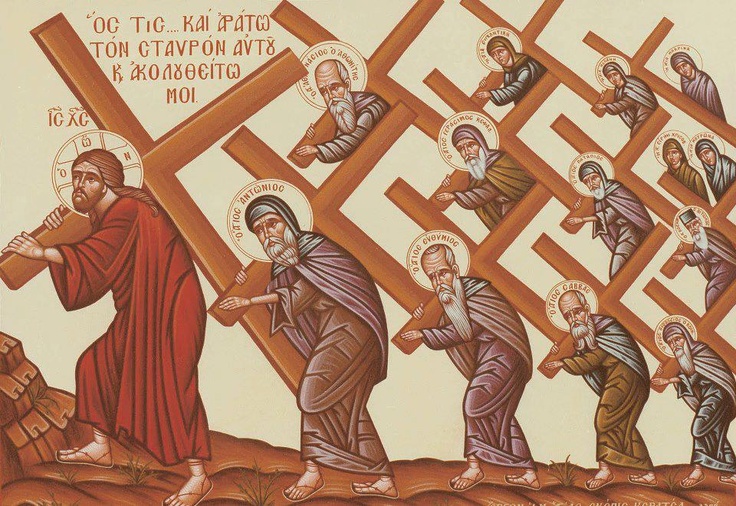
            Now Jesus introduces his disciples to a whole new dimension of his own identity and of their mission.  While at prayer in solitude, Jesus asks them, “Who do the crowds say that I am?”  They give the same opinions that Herod had heard, and, when Jesus asks, “But who do you say that I am?”  Peter responds, “The Messiah of God.”  But Jesus rebukes the disciples and directs them “not to tell this to anyone.”  Instead, he tells them that “The Son of Man must suffer greatly and be rejected by the elders, the chief priests, and the scribes, and be killed and on the third day be raised.”  And immediately Jesus adds, “If anyone wishes to come after me, he must deny himself and take up his cross daily and follow me.”   Although the disciples do not yet comprehend this feature of their own mission in imitation of  Jesus (see 9:45), he is preparing them for the greatest lesson of  all: “For whoever wishes to save his life will lose it, but whoever loses his life for my sake will save it” (9:24).

Monday, June 6, 2016

11th Sunday in Ordinary Time C

Readings: 2 Samuel 12:7-10, 13         Galatians 2:16, 19-21              Luke 7:36-8:3

            “Lord, forgive the wrong I have done.”  This refrain for the responsorial psalm (Psalm 32) captures the theme of this Sunday’s liturgy.  David, Paul, and the sinful woman in Luke all come to forgiveness through first admitting their sin.  Let us humbly follow their example and come to know the peace of the Lord’s forgiving love. 
            Despite the largely favorable picture of David in the story of his rise from a shepherd boy to becoming king of both Judah and Israel (1 Samuel 16 -2 Samuel 7), the last chapters of David’s reign chronicle his and Israel’s nearly tragic degeneration because of his sins (2 Samuel 11-20; 1 Kings 1-2).   After receiving from the prophet Nathan the glorious promise that his dynasty would last forever (2 Samuel 7), David, in typical despotic fashion, commits adultery with Bathsheba and orchestrates the murder of her husband Uriah during a war with the Ammonites (2 Samuel 11).  The Lord sends Nathan to confront David with his sins in the unforgettable parable of the ewe lamb in response to which the king condemns himself (see 1 Samuel 12:1-6).  Our reading begins with Nathan’s judgment oracle which first recalls the Lord’s gracious guidance of David. “Thus says the Lord God of Israel ‘I anointed you king of Israel.  I rescued you from the hand of Saul.  I gave you your lord’s house and your lord’s wives for your own.  I gave you the house of Israel and of Judah.  And if this were not enough,  I could count up for you still more.”  This past favor makes David’s ruthless actions all the more reprehensible.  “Why have you spurned the Lord and done evil in his sight?  You have cut down Uriah the Hittite with the sword;  you took his wife as your own, and him you killed with the sword of the Ammonites.”
            David’s punishment will fit his crime.  Nathan announces that “the sword shall never depart from your house.”  To his great credit David admits his sin without excuse: “I have sinned against the Lord,” and Nathan in turn assures him of the Lord’s forgiveness: “The Lord on his part has forgiven your sin: you shall not die.”  But, although David’s life is spared, the son Bathsheba has conceived will die, and the sword will nearly destroy the house of the king who displays a fatal weakness for indulging his sons.  The last chapters of David’s reign are marked by the death of three more of his sons as the royal family is ravaged by incest, fratricide, attempted patricide, and civil war (2 Samuel 13-20; 1 Kings 1-2).  In the midst of this ordeal, David is forced to abandon the city of Jerusalem as a chastened and penitent sinner (see 2 Samuel 15-16) and return only after his son Absalom has died (2 Samuel 17-20).
            The Epistle is taken from the conclusion of Paul’s defense of his apostolic credentials at the beginning of Galatians (Gal 1:10-2:21).  Paul is recounting an unpleasant incident at Antioch in which he chided Cephas (Peter) for being two-faced about the obligatory character of the Jewish dietary laws (2:11-14).  Paul is convinced that one must choose between justification through observance of the Torah or through belief in the saving death of Christ. The section ends with Paul’s statement of his gospel.  The “we” throughout refers to Peter and Paul, Jews by birth, who are not justified by their observance of the works of the law, but by their faith in and identification with the crucified Christ whose death and resurrection has brought them forgiveness of sin and the grace of God.  “I have been crucified with Christ; yet I live, no longer I, but Christ lives in me; insofar as I now live in the flesh, I live by faith in the Son of God who has loved me  and given himself up for me.  I do not nullify the grace of God; for if justification comes through the law,
then Christ died for nothing.”
            The Gospel reflects a favorite theme in Luke: self-righteous Pharisees and scholars of the Torah reject Jesus, while sinners believe in his message of forgiveness. Simon the Pharisee invites Jesus to eat with him, but he is offended when the “prophet” allows an anonymous sinful woman to touch him with extravagant gestures of gratitude.  He says to himself, “If this man were a prophet, he would know who and what sort of woman this is who is touching him, that she is a sinner.”  Jesus, knowing what is in Simon’s mind, answers by asking him to judge the parable of the two debtors which forces the Pharisee to admit that the one who is forgiven more will show greater love.  Jesus then goes on to contrast Simon’s failure to show the normal courtesies to him as a guest with the woman’s tender acts of gratitude for being forgiven her sins. “Do you see this woman?  When I entered your house, you did not give me water for my feet, but she has bathed them with her tears and wiped them with her hair.  You did not give me a kiss, but she has not ceased kissing my feet since the time I entered.  You did not anoint my head with oil, but she anointed my feet with ointment.  So I tell you, her many sins have been forgiven because she has shown great love.  But the one to whom little is forgiven, loves little.”  The scene ends with the woman being sent on her way with the assurance, “Your sins are forgiven. . . .  Your faith has saved you; go in peace”.  Let us admit our sins, turn from them and be open to Jesus’ gift of peace. 

Monday, May 30, 2016

10th Sunday C

10th Sunday in Ordinary Time C

Readings: 1 Kings 17:17-24   Galatians 1:11-19        Luke 7:11-17

            In this Sunday’s readings both the prophet Elijah and Jesus raise to life the dead sons of two grieving widows.  These mighty deeds foreshadow the good news of the gospel: Jesus’ own victory over the powers of sin and death through his cross and resurrection and our hope of bodily resurrection.  Let us identify with the raised sons and the grieving widow mothers as we sing the lyrics of the responsorial psalm.
“I will extol you, O Lord, for you drew me clear/ and did not let my enemies rejoice over me.  O Lord, you brought me up from the nether world;/ You preserved me from among those going down into the pit” (Ps 30:2).
            The story of Elijah the prophet and the widow from Zarephath in 1 Kings manifests the life-giving power of the Lord’s word to defeat the powers of famine and death.   The widow is a pagan from Zarephath in the territory of Sidon who has trusted the Lord’s promise through Elijah that if she gives him a meal from her scanty fare of flour and oil in time of famine, “The jar of flour shall not go empty, nor the jug of oil run dry, until the day when the lord sends rain upon the earth” (1 Kgs 17:7-16).  But now mysteriously her son falls sick and dies, and she presumes that despite her hospitality in hosting Elijah she has caused her son’s death by her sin.  In anger she chides the prophet, “Why have you done this to me, O man of God?  Have you come to me to call attention to my guilt and to kill my son?”   Elijah immediately orders that she give him her son and he carries him to the upper room where he was staying, lays him on his own bed, and calls out to the Lord in the following prayer: “O Lord, my God, will you afflict even the widow with whom I am staying by killing her son?”  He then stretches himself out over the child three times and calls upon the Lord, “O Lord, my God, let the life breath return to the body of this child.”  The Lord hears the prophet’s prayer and revives the child.  When Elijah returns the boy to his mother with the words, “See . . . your son is alive,” she proclaims that Elijah is indeed a man of God because “The word of the Lord comes truly from your mouth.”
            The Epistle from Galatians is part of Paul’s long apologetic defense of his apostleship to the Gentiles (1:10-2:21).  In this section he insists that his version of the gospel which did not demand circumcision and Jewish observance by the Gentiles comes directly through a revelation of Jesus the Christ and not through the human agency of the apostles in Jerusalem.  He also addresses the charges that he was once a persecutor of the Church of God by honestly admitting them.  “You have heard, I know, the story of my former way of life in Judaism.  You know that I went to extremes in persecuting the church of God and tried to destroy it. . . .”  His former zealous observance of Judaism makes his call to be an apostle to the Gentiles all the more remarkable.  In contrast to Luke’s dramatic versions of Paul’s call in Acts (see chs 9, 22, 26), Paul’s own description is quite simple and uses the language associated with the call of a prophet to the nations (see Jer 1:4 and Isa 49:1).  “But the time came when he who had set me apart before I was born and called me by his favor chose to reveal his Son through me, so that I might spread among the Gentiles the good tidings concerning him.”  Paul goes on to insist that he immediately began his apostolic mission in Arabia and Damascus and only three years later went to consult with Cephas (Peter) in Jerusalem.
            The story of Jesus raising up the dead son of the widow of Nain is unique to Luke’s gospel and is closely related to the story of the widow from Zarephath in our first reading and the evangelist’s theme that Jesus is mighty prophet like Elijah of old who is fulfilling the passage from the Book of Isaiah which he reads in the synagogue at Nazareth to inaugurate his ministry (Lk 4:16-30).  “The spirit of the Lord is upon me,/
because he has anointed me/ to bring glad tidings to the poor.  He has sent me to proclaim liberty to captives/ and recovery of sight to the blind,/  to let the oppressed go free,/ and to proclaim a year acceptable to the Lord” (Isa 61:1-2).  When Jesus announces “Today this scripture passage is fulfilled in your hearing,” the people of his hometown reject him as the mere “son of Joseph.” Jesus, in turn, states, “Amen, I say to you, no prophet is accepted in his own native place,” and cites the story of Elijah being sent to the pagan widow during the time of the famine rather than to one of the many widows of Israel (Lk 4:25-26; cf. 1 Kgs 17:7-24). 

In today’s Gospel selection, Jesus, like Elijah, has compassion on the widow who would have no financial support if her “only son” is dead.  His words and actions in performing the miracle both look forward to the resurrection and back to the miracle of Elijah.  Jesus steps forward and touches the litter as he says, “Young man, I bid you rise,” and in the same words as were used of Elijah in our first reading, Luke tells us, “Then Jesus gave him back to his mother” (1 Kgs 17:23).  The reaction of the crowd is like that of the widow in the Elijah story; fear seizes them and they praise God: “A great prophet has risen among us . . . God has visited his people!” (1 Kgs 17:24).  The widow and her son are among the poor and oppressed who are finding salvation in Jesus who, like Elijah of old, is destined to return to his Father in his ascension (2 Kings 2; Luke 9:28-36; 24; Acts 1).  

Monday, May 23, 2016

The Most Holy Body and Blood of Christ C

Unfinished Leonardo DaVinci
The Most Holy Body and Blood of Christ C

Readings: Genesis 14:18‑20  1 Corinthians 11:23‑26  Luke 9:11‑17

In the transition between the Easter season and ordinary time, the Church celebrates the Solemnity of the Most Holy Body and Blood of Christ.   This Sunday's readings present us with richness of the Eucharist as thanksgiving, as re-enactment of Jesus' sacrificial death for us, as anticipation of his return, and finally as pattern for our life in following Jesus. 
The Old Testament reading from Genesis recounts Melchizedek's blessing of Abram after his victory over four kings and the rescue of his nephew Lot (see Genesis 14).  Melchizedek is the king of Salem, or Jerusalem, and his meeting with Abram is a joyful meal in thanksgiving for the victory which has rid Canaanite territory of a foreign menace.   Early Christian writers understood this story as an anticipation of the Christian Eucharist and the priest‑king Melchizedek as a type for Christ (see Hebrews).  In the course of sharing a meal of bread and wine, Melchizedek blesses both Abram and God Most High who brought him victory. "Blessed be Abram by God Most High,/ the creator of heaven and earth;/ and blessed be God Most High,/ who delivered your foes into your hand." Our Eucharist shares this character of thanksgiving and blessing for a God's victory over sin and death in Christ.
The reading from Paul's first letter to the Corinthians is the earliest record of Jesus' actions and words at his final meal with his disciples on the night before he died.  "The Lord's supper" was celebrated both as a proclamation of Jesus' saving death and an anticipation of his return in glory.  Paul recounts that the Lord Jesus said of the broken bread: "This is my body, which is for you.  Do this in remembrance of me."  The cup is his blood which seals the new covenant promised by Jeremiah: "This cup is the new covenant in my blood. Do this, whenever you drink it, in remembrance of me."
Paul concludes by reminding the Corinthians that the Eucharist both proclaims Jesus' sacrificial death and anticipates his return in glory.  "Every time, then, you eat this bread and drink this cup, you proclaim the death of the Lord until he comes!"

The Gospel is Luke's account of the multiplication of the loaves and fishes.  It comes at a crucial turning point in Luke's story and draws a sharp contrast between the power of Jesus and his disciples.  Jesus is completing his Galilean ministry and is about to embark on his journey to Jerusalem where he will suffer, die, rise, and ascend to the Father.  His disciples have just returned from a successful journey on which they proclaimed the good news and cured diseases (Lk 9:1‑10).  Now Jesus challenges the Twelve to feed the crowds who have followed them to a "deserted place."  They are powerless to satisfy the needs of the group that numbers five thousand men alone and are forced to say:  “Five loaves and two fish are all we have, unless we ourselves go and buy food for all these people.”  Only Jesus, like the Lord who fed his people with manna in the wilderness (Exodus 16), can satisfy the needs of crowd.  He does so in a superabundant way that points to his mission to reconstitute the twelve tribes of Israel.  The account ends with the note: “They all ate and were satisfied.  And when the left‑ over fragments were picked up, they filled twelve wicker baskets.”
This meal both looks back to Jesus' actions in the Galilean ministry and forward to the events in Jerusalem.  In the opening sentence we are told, "Jesus spoke to the crowds of the reign of God, and he healed all who were in need of healing."  This is a summary of Jesus' work in the Galilean ministry (see Lk 4:14‑9:9).  Jesus' actions in feeding the people also anticipate the Last Supper and the breaking of bread in the Emmaus story.   In all three Jesus "blessed," "broke," and "gave" bread.  Luke is the only evangelist to link this feeding miracle to the confession of Jesus as the Messiah, his first prediction of the passion and resurrection, and the need for the disciples to follow him on this path (see Lk 9:18‑27).  To celebrate the Eucharist the disciples must share in Jesus’ mission to the poor and the sick (Lk 9:1‑6) and also must be willing to follow him to the cross.  After announcing that he must go to Jerusalem to be rejected, killed, and be raised on the third day, Jesus says to the disciples, "If anyone wishes to come after me, he must deny himself and take up his cross daily and follow me" (9:23).

Monday, May 16, 2016

Trinity Sunday C

Trinity Sunday C

Readings: Proverbs 8:22‑31  Romans 5:1‑5  John 16:12‑15

Rather than dwelling on the mystery of God's inner life, the readings for this feast of the Holy Trinity celebrate what God has done for us: the gift of an orderly creation, salvation through Christ, and guidance for our continued pursuit of the truth in Christ.  As we reflect on the mystery of God's love for us, let us joyfully sing the refrain of this Sunday's psalm, "O Lord, our God, how wonderful is your name in all the earth" (Ps 8).
The first reading from Proverbs is part of the speech of Lady Wisdom (hokmah, a feminine noun in Hebrew), who personifies the artistry of God's creation.  In the whole of her speech (see Proverbs 8), Wisdom invites the simple to come to her and receive the greatest gift of all: the path to life.  In our section, she is giving her credentials as God's “first‑born,”  “craftsman,” and “delight,” who “played” before God as he ordered the cosmos.   Using an onomasticon, listing the parts of the cosmos, Lady Wisdom asserts that, first of all, she existed before God's formation of the earth, the underworld depths, the mountains and hills; and secondly, that she was with God as he established the heavens, fixed the foundations of the earth, and set for the sea its limit.  Finally, Lady Wisdom says that her special delight was in humanity to whom she will extend the offer of life.  In the verses which follow today's reading, she invites us with the following words. "So now, O children, listen to me;/ instruction and wisdom do not reject!" . . . For the one who finds me finds life,/ and wins favor from the Lord; But the one who misses me harms self;/ all who hate me love death" (Prv 8:32‑36).
The Epistle from Romans is Paul's reflection on the hopeful situation of Christians who have already been "justified by faith" in Christ's death and resurrection and are now awaiting "the glory of God," the completion of God's kingdom.  In this tension-filled situation, Christians experience "afflictions," but they can boast of them as they endure in hope.  The foundation of their hope is what God has already done for them in his Son, Christ, and by the gift of his Spirit which has been poured out upon them in the Messianic age.  In Paul's words, "this  hope will not leave us disappointed, because the love of God has  been poured out in our hearts through the Holy Spirit who has  been given to us" (Rom 5:5).
The Gospel is from John's Farewell Discourse in which Jesus promises the disciples that, after his departure, the Spirit of truth will come to guide them “to all truth.”  Jesus' promise emphasizes two things about the Spirit or Paraclete's role.   First of all, he will continue the work of revelation that Jesus has done.  Jesus tells the disciples: "He will not speak on his own, but will speak only what he hears . . .In doing this he will give glory to me, because he will have received from me what he will announce to you."  Secondly, the Spirit will guide the disciples in their continued pursuit of the truth of God's mysterious love.  Jesus promises:  "I have much more to tell you, but you cannot bear it now. When he comes, however, being the Spirit of truth he will guide you to all truth."  This truth to which the Spirit guides us is an ever deeper entrance into the very mystery of God's life of love.  Jesus concludes this section with the words: "All that the Father has belongs to me. That is why I said that what he (the Spirit) will announce to you he will have from me."  

Monday, May 9, 2016

Pentecost

Pentecost Sunday A B C

Readings: Acts 2:1-11 1 Corinthians 12:3-7,12-13   John 20:19-23

“Lord send out your spirit, and renew the face of the earth” (Ps 104).  In remembering the first Christian Pentecost, we fervently pray in the refrain of the responsorial psalm that God’s Holy Spirit renew the world and the church with the gifts of unity, peace, joy and forgiveness.
The Acts reading describes the descent of the Holy Spirit on the disciples at the Jewish pilgrimage feast of Pentecost (Shavuoth) in fulfillment of prophetic expectations of the final age when all the nations will know the God of Israel.  Isaiah 66 speaks of God’s coming in the following way: “For behold the Lord will come as a fire . . . with a flame of fire . . . I am coming to gather all the nations and tongues” (Is 66:15.18).  As Peter will affirm in his Pentecost sermon, the prophet Joel announced: “God says: ‘It will come to pass in the last days,/ that I will pour out a portion of my spirit upon all flesh’” (Acts 2:17).  Luke’s account of Pentecost has all of these elements.  The Spirit descends upon the gathered group of one hundred and twenty would-be witnesses with a noise “like a strong driving wind.”  Tongues “as of fire” part and rest on each of them, and the Holy Spirit enables them to speak in different languages to Jewish pilgrims from most of the known world.  In a symbolic reversal of the confusion of tongues at the tower of Babel incident (Genesis11), the disciples speak in understandable languages of “the mighty works of God.”  As Peter will proclaim in his Pentecost sermon, Jesus’ death, resurrection and ascension have begun the final age when all are called to repent and be baptized in the name of Jesus Christ for the forgiveness of sins (Acts 2:14-41).
In the reading from 1 Corinthians, Paul insists that the Holy Spirit’s various gifts are meant for the common good of the community and for the unity of what were previously divided groups.  In Corinth some were using the possession of spectacular gifts like tongues as a basis for claiming superiority within the community.  Paul reminds the Corinthians that one Spirit gives various gifts--wisdom, knowledge, faith, healing, working miracles, prophecy, tongues and interpreting tongues--for the building up of the whole community, and not for the exaltation of the individual (12:4-11).  He also uses the body of Christ metaphor to express the interdependence of all members--Jews or Greeks, slave or free--upon one another because they share a common baptism “into one body.”

The Gospel selection is John’s account of the gift of the Holy Spirit to the apostles on Easter night.  John places all the key saving events--the Resurrection, the ascent to the Father and the bestowal of the Spirit--on Easter (John 20:1-23).  When Jesus appears to the disciples on the evening of that first day of the week, he has already ascended to the Father as he had announced to Mary Magdalene (John 20:17).  He can now give them the gifts he had promised in the farewell discourse: peace, joy, and the Spirit/Paraclete (John 14-17).  Twice he greets the apostles with “Peace be with you” (cf. John 14:27).  When they see his hands and his side as proof that he was crucified and has now returned to the Father, the disciples experience the joy that Jesus had promised them (cf. 16:20-24).  Finally, Jesus sends them into the world as he was sent by the Father.  He breathes on them and says: “Receive the Holy Spirit.  If you forgive men’s sins, they are forgiven them; if you hold them bound, they are held bound.”  As God “breathed” life into Adam in Genesis, Jesus is recreating the community of disciples with the life of God’s forgiving love.

Monday, May 2, 2016

Easter VII C

7th  Sunday of Easter C

Readings: Acts 7:55-60  Revelation 22:12-14,16-20  John 17:20-26

On this Sunday between the feasts of Jesus’ Ascension and Pentecost, the liturgy calls us to unity with both the risen Jesus and one another in the very love of God.  In this age of religious, racial, and social factionalism we are challenged, in the concluding words of the second reading, to pray for the coming of Jesus’ Kingdom of love.  “Amen!  Come, Lord Jesus!”
Luke’s account of Stephen’s martyrdom in Acts highlights his fearless commitment to following Jesus, even to the point of forgiving his executioners.  In the previous section of Acts, Stephen has testified in a long speech before the Sanhedrin that, as Jesus himself had said (Lk 21:5-6), the temple is not a permanent institution and that the execution of Jesus was simply the culmination of repeated rejections of God’s prophets (7:2-53).  Infuriated by Stephen’s charges, the council drags him out of the city and begins to stone him.  In his death Stephen is united with the risen Jesus. Filled with the Holy Spirit, he sees the glory of God with Jesus, as the glorious Son of Man, standing at God’s right hand.  Like Jesus (Lk 23:46), Stephen prays and hands over his spirit with the words: “Lord Jesus, receive my spirit.”  Finally, in imitation of his master, Stephen forgives his murderers, as he cries out in a loud voice, “Lord, do not hold this sin against them” (Lk 23:34).
Stephen’s death does not stop the preaching of the gospel; on the contrary, it sets in motion the spread of “the Way” beyond Jerusalem.  Despite the persecution that breaks out against the church in Jerusalem, the gospel is preached through the ministry of Philip and Peter in Samaria, Judea and Galilee (Acts 8:1-40; 9:31-43).  Even Saul, who participates in Stephen’s execution, will be converted from a persecutor of “the Way” to the ‘chosen instrument’ who will carry Jesus’ name before the Gentiles (Acts 9:1-30).
The second reading is a series of prophetic oracles from the conclusion of the Book of Revelation.  Jesus, as “the Alpha and the Omega, the first and the Last, the Beginning and the End,” warns John that he is coming soon and the righteous will be rewarded.  In the early Church, the nearness of Jesus’ coming is regularly tied to exhortations to be faithful to the Christian way of life.  In our own time, such warnings challenge us to believe that God is not far off, but very much involved with the ethical and social issues we face.  Only fidelity to the gospel will enable us, in the words of Revelation, to “wash” our “robes so as to have free access to the tree of life and enter the city (the heavenly Jerusalem) through its gates.”
The reading concludes with a mutual summons to “come.”  Righteous Christians are invited by the Spirit and the Bride (the glorified Church of martyrs) to come to the Eucharistic celebration: “Let him who is thirsty come forward, and let all who desire it accept the gift of life-giving water.”  They in turn pray to the Lord to come: “Amen!  Come, Lord Jesus!”  We who long for the completion of Jesus’ Kingdom come to the Eucharistic feast which celebrates the future Messianic banquet.

The Gospel is the conclusion of Jesus’ prayer to his Father at the end of the farewell discourse in John 17.  Jesus prays that we, those who have come to believe through the disciples’ words, may be one as he and the Father are one.  This is the goal of Jesus’ mission in John’s Gospel.  His act of love in laying down his life reveals the glory of God’s love for humanity, and now that glory is to be given to the community of his followers.  “I have given them the glory you gave me, that they may be one, as we are one—I living in them, you living in me--that their unity may be complete.  So shall the world know that you sent me, and that you love them as you loved me”  (17:22-23).  The basis for this unity is the indwelling of God’s own love, the eternal love the Father has for the Son.  “Father, all those you gave me I would have in my company where I am, to see the glory of mine which is your gift to me, because of the love you bore me before the world began” (17:24).
As we work for unity within the Roman Catholic Church and among the various Christian communions, let us remember that this unity will never be achieved through the force of political power nor by the shrillness of acrimonious debate, but only through the sign of love modeled on Jesus.  Jesus’ concluding words are: “To them I have revealed your name, and I will continue to reveal it so that your love for me may live in them, and I may live in them” (17:26).