Monday, February 17, 2020

7TH Sunday A

Image result for be perfect as your heavenly father is perfect meaning
7th Sunday in Ordinary Time A

Readings: Leviticus 19:1‑2, 17‑18  1 Corinthians 3:16‑23  Matthew  5:38‑48

            Today's readings challenge us with Jesus' two most radical ethical teachings: the command to demand no justice for injury and the command to love and pray for enemies.  As we struggle to be faithful to Jesus' revolutionary teaching, let us remember God's own mercy and pray in the words of our responsorial psalm: "The Lord is kind and merciful" (Ps 103:8a).
             The Lord's command to Moses in the first reading from Leviticus lays the foundation for Jesus' teaching about love of neighbor in the Sermon on the Mount.  First of all, the Lord commands Israel, "Be holy, for I, the Lord, your God, am holy."  The word "holy," qadosh in Hebrew, means "separate" or "other."   Israel is to be different from the other nations by imitating God's own love.  The Lord commands them: "You shall not bear hatred for your brother or sister in your heart. . . . Take no revenge and cherish no grudge against any of your people. You shall love your neighbor as yourself. I am the Lord.” Jesus simply radicalizes these teachings of the Torah by extending them even to the love of one's enemy. 
            In the second reading Paul continues his treatment of the problem of factionalism in the Corinthian church by reminding its members of their privileged status as "God’s temple" as the dwelling of God's Spirit.  He warns them that "God will destroy" anyone who "destroys God's temple" with a boastful factionalism rooted in claims to worldly wisdom.  The only way to  preserve the unity of "the temple" is for the Corinthians to give  up "their boasting about human beings" and embrace the folly of the cross by living the kind of radical love Jesus speaks about in today's gospel (see also 1 Corinthians 13).

            The Gospel completes Jesus' interpretation of his ancestors' Scriptures which began with last week's reading.  With the final two antitheses Jesus both overthrows and radicalizes commands in the Torah concerned with justice between "neighbors."  Originally, the law of retaliation ‑‑"an eye for an eye, a tooth for a tooth,"‑‑ was a good command because it put a limit on the human tendency to take unlimited revenge for an injury done to one's person or family (see Ex 21:24; Lev 24:20; Deut 19:21).  For Jesus' followers, however, a higher righteous is demanded‑‑ one that overturns the normal standards of all human justice systems.   When they have received an injury, Jesus' disciples are commanded not to seek the justice that a reasonable law would give them. "But what I say to you, offer no resistance to one who is evil. When someone strikes you on your right cheek, turn the other as well.  If anyone wants to go to law over your tunic, hand him your coat as well. . . ." Only a few saints, who shared Jesus' vision of the "kingdom of heaven," have been able to follow this command.  Only when we have been remade by the grace of that kingdom will we be able to do the same.
The last of the antitheses radicalizes the love of the neighbor command from the Leviticus reading.  A popular interpretation of that command was to limit the term neighbor to one's fellow countryman and encourage hatred of foreign enemies. "You have heard the commandment, `You shall love your countryman but hate your enemy.'" Jesus rejects this narrow nationalistic reading and tells his followers: “But I say to you, love your enemies and pray for those who persecute you.”  The basis Jesus offers for this radical teaching is found in our first reading from Leviticus where God commands Israel: "Be holy, for I, the Lord, your God, am holy."   Jesus' revelation of God is that of a benevolent Father who is indiscriminate in his love.  To be children of such a Father is to imitate that unconditional love: “for he makes his sun rise on the bad and the good, and causes rain to fall on the just and the unjust.”  To only love those who love you is not to act as a true Israelite who has been grasped by God's kingdom, but is to behave like a tax collector or a pagan.“If you greet your brothers only, what is unusual about that?  Do not the pagans do the same?” Jesus' followers are commanded to imitate the perfection of God's indiscriminate love. “So be perfect, just as your heavenly Father is perfect.”

Monday, February 10, 2020

6th Sunday A

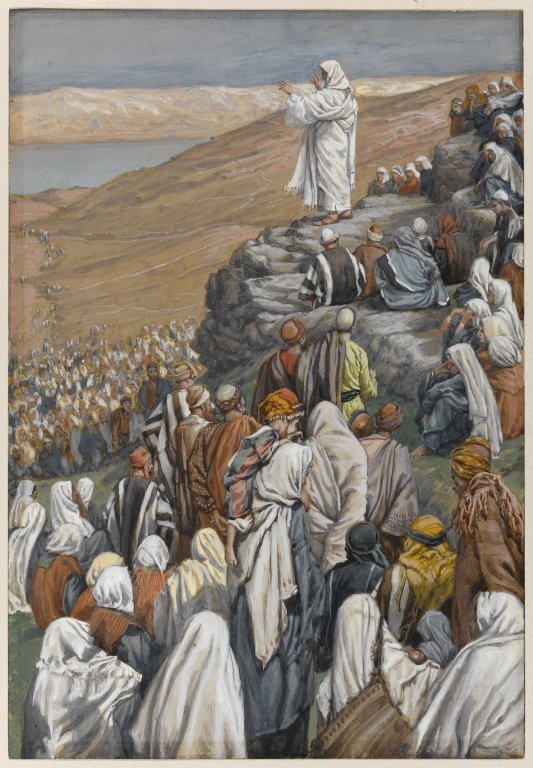
Image result for sermon on the MT6th Sunday in Ordinary Time A

Readings: Sirach 15:15‑20  1 Corinthians 2:6‑10  Matthew 5:17‑37

            “Do not think that I have come to abolish the law or the prophets.  I have come, not to abolish but to fulfill” (Matt 5:17).  In today's Gospel Matthew presents Jesus as the final interpreter of God's revelation in the law and the prophets.  Let us confidently commit ourselves to follow Jesus' commands by praying the refrain of our responsorial psalm: "Blessed are they who follow the law of the Lord!" (Ps 119:1b).
            In the first reading Sirach is arguing against those who hold for a determinism that said  humans have no free will and that God forces some people into sin (Sirach 15:11‑12).  Against this position which would undermine any sense of responsibility for one's actions, Sirach asserts that humans are free to choose either life or death:  “If you choose you can keep the commandments,/ they will save you . . ./ Before man are life and death,/ whichever he chooses shall be given him.”  Sirach concludes his exhortation by insisting that, although God's immense wisdom sees and understands all, "No one does he (God) command to act unjustly,/ to none does he give license to sin”.
            Our second reading from 1 Corinthians continues Paul's explication of the paradox of the cross of Christ.  His tone in this section is ironic and sarcastic.  Paul’s opponents at Corinth claim to have an elite status in the Christian community because of their superior "wisdom" which makes them spiritually “mature."  Paul uses their own language to ridicule their understanding of Christianity as belonging to "this age" which is "passing away."  The real "mysterious" and "hidden" wisdom of God is the cross of Christ which is completely incomprehensible to those who embrace Christianity out of a desire for worldly wisdom and status.  Paul reminds the Corinthians that this is a wisdom which "none of the rulers of this age knew for, if they had known it, they would never have crucified the Lord of glory."
            For the next two Sundays the Gospel readings will be from  the section of Matthew's Sermon on the Mount in which Jesus  fulfills "the law and the prophets" by giving an authoritative  interpretation of six commandments in the Jewish Torah (Matt 5:17‑48). Each instance is introduced by slight variants of the same formula: “You have heard that it was said to your ancestors. . . But I say to you . . .”   With God-like authority Jesus states the commands first spoken by God on Mount Sinai and then gives them their final meaning.  These six examples are meant to be illustrative rather than exhaustive.  They give us a glimpse of how we are to live in the kingdom of heaven.  Jesus warns his disciples that they are called to a higher righteousness than that of the legalistic scribes and Pharisees (Matt 5:20; see Matthew 23).

            Jesus fulfills the command against murder (Ex 20:13; Deut 5:17) by affirming it but then adding to its demands in a way which goes to the root cause of the sin. "But I say to you, who-ever is angry with his brother will be liable to judgment, and whoever says to his brother, `Raqa' ("empty‑headed"), will be answerable to the Sanhedrin, and whoever says, `You fool,' will be liable to fiery Gehenna." For Jesus' followers, all acts of anger and abusive behavior toward human beings are equally serious.  Jesus then gives two parables as conclusions that follow from these demands.  First of all, reconciliation with the brother takes precedence over liturgical ritual.  "Therefore, if you bring your gift to the altar, and there recall that your brother has anything 
 against you, leave your gift there at the altar, go first and be reconciled with your brother . . ." Secondly, he urges his disciples to settle any judicial disputes before they come into the courts.   
            Likewise, Jesus affirms the command prohibiting adultery (Ex 20:14; Deut 5:18) and goes on to condemn the interior attitude which leads to the act. "But I say to you, everyone who looks at a woman with lust has already committed adultery with her in his heart." A woman's dignity is so sacred that it is not to be violated even by the lustful intentions of men.  The sayings about the "right eye" and "right hand" which follow are hyperboles which stress removing the cause of sin so as not to risk losing the whole of one's life in Gehenna (Hell).
            Jesus' interpretations of the commands allowing divorce and oaths actually overturn the old law.  Rather than allowing men to dismiss women with "a bill of divorce" for the slightest of reasons (see Deuteronomy 24), Jesus declares: ". . . whoever divorces his wife-- unless the marriage is unlawful-- causes her to commit adultery, and whoever marries a divorced woman commits adultery."  In the context of the Judaism of Jesus and Matthew’s day, this command protected women's rights against the arbitrary actions of their husbands.  
Finally, Jesus' command prohibiting the use of oaths and vows which were allowed in Jewish law (see Ex 20:7; Lev 19:12; Num 30:3; Deut 23:22) is designed to protect the name of the all truthful God from being brought into our petty human affairs where we all too often lie and cheat.  We humans are not to imagine that God is at our beck and call to witness our oaths and vows.  Rather, we are to aim at truthfulness and honesty in our dealings with others. "But I say to you, do not swear at all; not by heaven, for it is God's throne; nor by the earth, for it is his footstool; nor by Jerusalem, for it is the city of the great King. . . . Let your `Yes' mean `Yes,' and your `No' mean `No.' Anything more is from the evil one."     

Monday, February 3, 2020

5th Sunday A

Image result for sermon on the MT"
5th Sunday in Ordinary Time A

Readings: Isaiah 58:7‑10   1 Corinthians 2:1‑5   Matthew 5:13‑20

"You are the salt of the earth. . . . You are the light of the world."  Jesus' challenge to his disciples in today's Gospel is also addressed to us who live in a culture that is as "flat" and "blind" as was the world of Jesus' own day.  As we struggle to be faithful to Jesus' commission, let us pray with confidence the refrain of this Sunday's responsorial psalm: "The just man is a light in darkness to the upright" (Ps 112:4a).
The Isaiah reading was spoken in the dark days immediately after the return of the Babylonian exiles to Jerusalem when they found their city and temple in ruins.  Instead of caring for the poor and homeless, many selfishly pursued their own business, while conducting meaningless fasts which the prophet describes in the lines preceding our reading.  “Lo, on your fast day you carry out your own pursuits, and drive all your laborers,/ yes, your fast ends in quarreling and fighting, striking with wicked claw” (Isa 58:3‑4).  In God's name, the prophet demands: “This, rather, is the fasting that I wish./ Release those bound unjustly,/ untie the thongs of the yoke,/ set free the oppressed,/ break every yoke./ Share your bread with the hungry,/ shelter the oppressed and the homeless;/ clothe the naked when you see them,/ and do not turn your back on your own” (Isa 58:6‑7). Only after Israel rectifies the injustices in its midst will it be healed and become a light for a darkened world (58:8). 
The second reading continues Paul's attack on the worldly factionalism among the Corinthians.  He reminds them that his initial preaching of the gospel was not done "with sublimity of words or wisdom."  Rather, he spoke only of "Jesus Christ, and him crucified."  As befits a message about a crucified Messiah, he came to them "in weakness and fear, and much trembling."  For Paul, the success of the Christian gospel does not depend upon the preacher's gift for "persuasive words of wisdom," like some worldly sophist, but on "a demonstration of Spirit and power" working through weak human instruments who reflect the message of the cross in their own lives.  The cross is God's "mysterious" and "hidden" wisdom which "the rulers of this age" cannot understand, as is proven by their crucifying "the Lord of glory." 

The Gospel continues last Sunday's reading which ended with the beatitude for those persecuted for the sake of the gospel (Matt 5:11‑12).  Now Jesus uses two striking metaphors to alert his disciples to the importance of their role in the world.  They are to be "the salt of the earth" and "the light of the world."   Salt was important in Jesus' world as both a spice and a preservative.  Both qualities apply to the disciples' task.  They must both challenge the world with Jesus' teachings and preserve the deepest meaning of God's Torah (see Matthew 10, 18, 28).  But Jesus ends with a threat of judgment. “But if salt loses its taste, with what can it be seasoned?  It is no longer good for anything but to be thrown out and trampled underfoot.” 
Strictly speaking, salt cannot lose its taste, but in Judaism it can become unclean when tainted with too many impurities, and then it has to be thrown out.  The disciples are warned that, despite their call, they may lose all if they are unfaithful in time of persecution.  
The light image is based on the tradition in the first reading from Isaiah.  A traditional Jewish hope was that Israel and the city of Jerusalem would become "a light for the nations" by manifesting God's justice (see Isa 2:1‑5; 42:1‑9).  Notice that although the disciples' "good deeds" are to be like "a city set on a mountain top" and a light “set on a lamp stand where it gives light to all in the house," they are not to draw attention to themselves, but to bring the nations to God. “Just so, your light must shine before others, that they may see your good deeds and glorify
your heavenly Father” (Matt 5:16).

Monday, January 27, 2020

Presentation of the Lord

Image result for presentation of the lord
Presentation of the Lord (February 2)

Readings: Malachi 3:1-4         Hebrews 2:14-18         Luke 2:22-40

            With the feast of the Presentation, the forty-day Christmas season comes to its true climax.  As Christian believers receive blessed candles and process into the church, the community celebrates the joyous purpose of Christ’s coming: the revelation of God’s saving love to the lowly and faithful of Israel and to the whole Gentile world.  On a more somber yet consoling note, the community learns that this savior is “a sign that will be opposed” as he comes to establish justice and expiate sin as a suffering but also “merciful and faithful” high priest who will help us in our temptation-filled journeys in the service of God’s justice.
            The first reading from Malachi announces the terrible yet purifying arrival of the Lord of hosts in the Temple.  In the half century after the completion of the Second Temple (c. 515-450), the once fervent postexilic community lapsed into indifference in cultic matters (Mal 1:6-14) and neglect of covenantal justice (Mal 2:10-16; 3:5).  The apparent prosperity of the wicked had led many to question even the justice of God (Mal 2:17).  Responding to this general malaise, the prophet as “God’s messenger” (the meaning of Malachi) announces the imminent arrival in the Temple of the holy God of justice who will purify the sons of Levi, known to be performing shoddy services for the community, so that the sacrifices of Judah and Jerusalem will again be acceptable to the Lord.  In the next verse (3:5), unfortunately not included in the reading, the prophet announces the Lord’s judgment on the sins against covenantal justice of the whole community: “I will draw near to you for judgment,/ and I will be swift to bear witness against the sorcerers, adulterers, and perjurers,/ those who defraud widows and orphans;/those who turn aside the stranger,/ and those who do not fear me, says the Lord of hosts.”
            Hebrews is a treatise written as an exhortation to Christians who are in danger of apostasy, not because of external persecution but from a weariness in living the demands of the Christian calling (see Heb 2:1; 4:14; 6:1-12; 10:23-32).  To counteract this indifference to the gospel’s demands, Hebrews presents Jesus in a unique way as “the merciful and faithful high priest” who had a full share in humanity’s condition of being in flesh and blood, including a life of testing, temptation, suffering and death.  Jesus’ death was not a defeat, but rather a victory that robbed “the devil, the prince of death,” of power.  Now that Jesus has triumphed through his testing, he is the exalted heavenly high priest who is able to help the children of Abraham; they too must struggle to be faithfully obedient through a pilgrimage of testing and suffering.  “Since he was himself tested through what he suffered, he is able to help those who are tempted.”
            Luke’s account of the child Jesus’ presentation in the Temple by his pious parents is not only intended to recount the surprisingly joyful fulfillment of messianic expectations but also to introduce the ominous note of opposition, rejection and suffering in Jesus’ ministry   His arrival in the Temple begins the fulfillment of Malachi’s prophecy (Mal 3:1); by the end of the gospel and throughout Acts, it will be clear that the Temple is doomed for its rejection of Jesus (cf. 13:34-35; 19:41-48; 21:5-6; Acts 7).  Like the pious Zechariah and Elizabeth (1:6), Jesus’ parents fulfill the laws for the purification of the mother (cf. Lev 12:2-8) and the dedication of the first-born (Ex 13:2, 12).  The fact that Jesus is brought to the temple for the second ritual, which is not required in the law (Exodus 13; Num 3:47-48), is important for Luke’s theology and is probably based on the parallel story of Samuel’s presentation in 1 Sam 1:24-28. 
The centerpiece of today’s Gospel scene is Simeon’s Nunc dimittis.  As a representative of the `anawim, the poor of the Lord who await the kingdom of justice, Simeon is moved by the Holy Spirit to take Jesus in his arms and proclaim the good news of the long-awaited arrival of the “light of revelation to the Gentiles” (cf. Isa 40:5; 49:6).  Simeon’s prophetic vision also encompasses the divisive character of Jesus’ ministry.  His proclamation of the Father’s forgiving love is destined to bring about the downfall and rise of many in Israel (see, for example, Luke 7).  Mary’s own blessedness will be challenged by Jesus himself when he announces that true blessedness is “hearing the word of God and observing it” (cf. 1:38-45; 2:19; 8:20-21; 11:27-28).  Using a familiar Lukan technique, the evangelist pairs Simeon and Anna, another of the `anawim, who as a prophetess thanks God for the Messiah’s arrival and begins to talk about the child “to all who looked forward to the deliverance of Jerusalem.” 

Monday, January 20, 2020

3rd Sunday A

3rd Sunday in Ordinary Time A
Related image

Readings: Isaiah 8:23‑9:3  1 Corinthians 1:10‑13,17  Matthew 4:12‑23

In today's Gospel Matthew presents the beginning of Jesus' public proclamation of the kingdom of heaven as the fulfillment of Isaiah's prophecy of "a great light" arising for "a people living in darkness."   As we hear the beginning of Jesus' preaching in Galilee, let us identify with the first apostles‑‑ Peter, Andrew, James, and John‑‑ by responding whole‑heartedly to the demands of God's kingdom with the refrain of the responsorial psalm: "The Lord is my light and my salvation" (Ps 27:1a). 
The Isaiah reading is the opening section of a messianic oracle which describes the Lord's deliverance of Israel from the Assyrian armies.  At first, the Lord had "degraded the land of  Zebulun and the land of Naphtali" by allowing Assyria under Tiglath‑pileser III to take captives and territory from those  tribes, but now "he has glorified the seaward road, the land west  of the Jordan, the District of the Gentiles" through a mighty deliverance of his people from the Assyria imperialists.  The prophet goes on to praise the Lord for his victory. “The people who walked in darkness have seen a great light;/ Upon those who dwelt in the land of gloom a light has shone.” The people of Israel rejoice "as at the harvest" or “when dividing spoils," because the Lord has smashed "the yoke that burdened them,/ the pole on their shoulder,/ and the rod of  their taskmaster . . . as on the day of Midian" (cf. Judges 6-7).
In the second reading from the beginning of 1 Corinthians, Paul is combating the problem of factionalism.  The Corinthian community has divided into groups claiming allegiance to Paul, Apollos (another apostle from Alexandria in Egypt), Cephas (Peter), and Christ.   For Paul such division is rooted in a misunderstanding of the gospel message.  The Christian gospel is not the "wisdom" of a particular Christian preacher.  In fact, by the standards of philosophical wisdom, the gospel is “folly” because its content is the cross, i.e., the message about Jesus, a crucified Messiah.   Paul asks the Corinthians, who seem to be allied to the apostle who had baptized them, "Is Christ divided?  Was it Paul who was crucified for you?  Or were you baptized in the name of Paul?”   He then reminds them of the difference between the worldly wisdom of philosophy and the power of the cross. “For Christ did not send me to baptize but to preach the
gospel, and not with the wisdom of human eloquence, so that the cross of Christ might not be emptied of its meaning.”

Matthew's account of the beginning of Jesus' preaching proclaims that a new age has dawned when the light of salvation is manifest to the whole world.  John's arrest serves as a kind of signal for Jesus to begin his mission.  After first withdrawing from the desert of Judea to Galilee, Jesus leaves his home town of Nazareth and takes up residence in Capernaum, a small fishing village on the northern shores of the Sea of Galilee.  Despite the apparent obscurity of this place in contrast to the capital and temple city of Jerusalem, Matthew understands Jesus' Galilean ministry as the ultimate fulfillment of Isaiah's ancient prophecy. "Land of Zebulun, land of Naphtali/ the way to the sea, beyond the Jordan, heathen Galilee:/ a people living in darkness has seen a great light./ On those who inhabit a land overshadowed by death, light has arisen."
Jesus' initial preaching is exactly the same as John's:  “Repent for the kingdom of heaven is at hand!” (cf. Matt 3:2).  The term “kingdom of heaven” is Matthew's reverent paraphrase for "kingdom of God."  It does not mean heaven in the sense of a disembodied afterlife with God, but rather it refers to the arrival of God's kingdom of justice and peace within this world, as will be evident in Jesus' preaching in the Sermon on the Mount (Matthew 5‑7).
In contrast to John whose mission was limited to preaching repentance and baptizing in the desert of Judea (Matthew 3), Jesus begins a more public and universal mission by calling common fisherman to leave their nets and become “fishers of men” (see Jer 16:11).  Eventually their mission will extend to all the nations (see Matt 28:16‑20).  This universality is anticipated in Jesus' initial tour through the whole of Galilee which Matthew summarizes in the following way. “He went around all of Galilee, teaching in their synagogues, proclaiming the gospel of the kingdom, and curing every disease and illness among the people.”  Our lives as Christian are to be a joyful extension of that universal healing mission.

Monday, January 13, 2020

2nd Sunday A

Image result for behold the lamb of god
2nd Sunday in Ordinary Time A

Readings: Isaiah 49:3,5‑6  1 Corinthians 1:1‑3  
John 1:29‑34

In these Sundays of Ordinary Time between the Christmas season and Lent, the Church presents us with the demands of our Christian vocation.  We are called to be a holy people who, like John the Baptist in the Gospel, give testimony to the presence of Jesus in our midst.  Let us open ourselves to the rigors of that call as we sing the refrain of this Sunday's responsorial psalm: "Here am I, Lord;/ I come to do your will" (Ps 40:8a and 9a).
            In the first reading the prophet Second Isaiah speaks of Israel's vocation in the language of a prophetic call.  Influenced by the humiliation of the nation's exile in Babylon, Second Isaiah envisions a new task for Israel; it is to be God's "servant" (`ebed).  Speaking as if he is servant, Israel, the prophet gives a first person report of Israel's coming to a new understanding of its vocation.  Not only is Israel called to repent of its sins in exile and be gathered to the Lord, but now it is to be "a light to the nations" by witnessing to the Lord's powerful saving action in bringing the nation home from exile. “The Lord said to me: you are my servant,/ Israel, through whom I show my glory./ Now the Lord has spoken who formed me as his servant from the womb,/ that Jacob may be brought back to him/ and Israel gathered to him;/ . . . It is too little . . . for you to be my servant,/ to raise up the tribes of Jacob,/ . . . I will make you a light to the nations,/ that my salvation may reach to the ends of the earth.” 
Paul's greeting at the beginning of First Corinthians continues the theme of God's call.  In his salutation Paul stresses both his own call and that of the community at Corinth.   As he often does in his letters, Paul identifies himself by giving his apostolic credentials: "Paul, called to be an apostle of Christ Jesus by the will of God".  His message is never simply his own; it is always related to his mission to be an apostle of the crucified and risen Christ.   "The Church of God that is in Corinth" also has a call based on what Christ has done for it.  Paul addresses the Corinthian Christians with the words:  "you who have been sanctified in Christ Jesus and called to be a holy with all those everywhere who call upon the name of our Lord Jesus Christ, their Lord and ours."  This is language taken from the Hebrew Scriptures where Israel is called to be "kingdom of priests, a holy nation" (Exod 19:6; see also Lev 19).  As Paul will elaborate in the body of the letter, the Corinthians have been consecrated at a great price, the very blood of the crucified  Christ, which has made the whole community and the individuals who make it up, "the temple of God" and "the  body  of Christ" (see 1 Cor 3:16‑17; 5:12‑20; 11:17‑34; 12:12‑26). As such, they are called to live holy lives of loving consideration for one another (see 1 Corinthians 13).

This Sunday's Gospel is John the Baptist's testimony to Jesus from John's gospel.  The Baptist has the role of the first witness to Jesus' identity as the saving light who has come from God (see John 1:6‑9).  Therefore, when Jesus appears in Bethany across the Jordan, John immediately identifies him with the words: "Behold, the Lamb of God, who takes away the sin of the world.  He is the one of whom I said, ‘a man is coming who ranks ahead of me because
he existed before me.'"
John goes on to speak of his own task “in baptizing with water” in order to make Jesus “known to Israel.”  He admits that at first he did not recognize Jesus, but he testifies that “the one who sent me to baptize with water told me, ‘On whomever you see the Spirit come down and remain, he is the one who will baptize with the Holy Spirit.’”  When John sees the descent of the Spirit upon Jesus, he performs his task: “Now I have seen and testified that he is the Son of God.” 
As we meditate on our own Christian vocations, we might humbly take John the Baptist as our model.  He does not proclaim himself or claim any title for himself (see John 1:19‑21).  He is content with the role of pointing to “the one among you whom you do not recognize” (John 1:26).  When the priests and Levites from Jerusalem ask John to identify himself, he simply says: "I am ‘the voice of one crying out in the desert, "Make straight the way of the Lord,’” as Isaiah the prophet said." (John 1:23) 

Monday, January 6, 2020

Baptism of the Lord A

Related image
Baptism of the Lord A 

Readings: Isaiah 42:1-4, 6-7    Acts 10:34-38      Matthew 3:13-17

The feast of the Baptism of the Lord marks a transition between the Christmas season, during which we celebrate the mystery of the incarnation, and the beginning of Ordinary Time, when we re-experience the saving mission of Jesus by commemorating his public actions and teachings as recorded in the various gospels.  During this year’s A cycle of readings we will hear Matthew’s Gospel, and so today we are presented with Matthew’s account of Jesus’ baptism.  Today’s feast reveals Jesus as God’s obedient Son and servant who has been anointed with God’s powerful Spirit to bring “the good news of peace” to the children of Israel and the nations of the world.  In the words of the refrain for the responsorial psalm, we pray: “The Lord will bless his people with peace” (Ps 29:11b).
In the first reading from the Book of Isaiah, Israel’s vocation as the Lord’s humble “servant” is to bring forth justice to the nations.  In contrast to the grandiose political expectations of nationalistic prophets, Second Isaiah, who is living in exile in Babylon, sees Israel fulfilling its task through a gentle preaching mission: “. . . not crying out, not shouting,/ not making his voice heard in the street./ A bruised reed he shall not break,/ and a smoldering wick he shall not quench,/ until he establishes justice on the earth;/ the coastlands will wait for his teaching.”
No longer can the exiles understand their destiny in narrow nationalistic terms.  They must now see themselves “as a covenant of the people,/ a light for the nations.”  We Christians believe Jesus, the crucified Messiah, is the ultimate fulfillment of this gentle servant figure.
In the reading from the Acts of the Apostles, Peter’s sermon at the baptism of Cornelius also alludes to the universalism implicit in Jesus’ ministry which began with John’s baptism when he was anointed with “the Holy Spirit and power.”  Cornelius is the first Gentile convert to Christianity in Acts; he was a devout Roman centurion who was already praying to the God of the Jews and giving alms to them (Acts 10:1-8).  As always in Luke-Acts, the initiative for this all important stage in the spreading of the gospel has come from God.  In a vision an angel of God tells Cornelius: “Your prayers and almsgiving have ascended as a memorial offering before God.  Now send some men to Joppa and summon one Simon who is called Peter” (Acts 10:4).  In the meantime, Peter also learns through a vision that God has overridden the Jewish dietary laws by declaring that all foods are clean, so that he goes with Cornelius’ emissaries when they invite him (Acts 10:17-29).  When Peter hears of Cornelius’ vision, he affirms all that God has done by beginning his sermon with the words: “In truth, I see that God shows no partiality. Rather, in every nation whoever fears him and acts uprightly is acceptable to him.”

Although Matthew’s baptism scene is very brief, it is filled with theological significance.  In the dialogue between John and Jesus, the Baptist recognizes that Jesus is his superior. Upon seeing Jesus, he exclaims, “I need to be baptized by you, yet you are coming to me!”  Jesus replies with his first spoken words in the gospel: “Allow it for now for thus it is fitting for us to fulfill all righteousness.”  In Matthew, Jesus will be God’s obedient son who brings righteousness by fulfilling or bringing to completion the will of God expressed in the Law and the Prophets (see Matt 5:17-20).
God’s approval of Jesus’ obedience in this first public act is evident in the solemn revelatory scene which follows the baptism. “After Jesus was baptized, he came up from the water and behold, the heavens were opened for him, and he saw the Spirit of God descending like a dove and coming upon him.”  The descent of God’s Spirit upon Jesus is his “anointing” as the Messiah, the long-awaited Son of God promised in the Jewish Scriptures (2 Sam 7:14; Ps 2).  Jesus is not, however, the powerful political and military Messiah expected in some traditions.  God’s heavenly voice identifies him with the gentle servant of the first reading from Isaiah:  “This is my beloved Son, with whom I am well pleased.”  As we listen to the teaching of Jesus in Matthew’s gospel throughout this year, we will be fully instructed by this Jesus who says: “Come to me all you who labor and are burdened, and I will give you rest. Take my yoke upon you and learn from me, for I am meek and humble of heart; and you will find rest for yourselves. For my yoke is easy, and my burden light.”  (Matt 11:28-30)