Monday, August 17, 2020

21st Sunday A

21st Sunday in Ordinary Time A

Readings: Isaiah 22:15, 19‑23  Romans 11:33‑36  Matthew 16:13‑20

            This Sunday's liturgy celebrates Peter's confession of faith  in Jesus as "the Messiah, the Son of the living God" and Jesus'  promise to Simon Bar Jonah that he will become the "Rock" (petros) upon whom Jesus will build his Church.  Let us pray for the Lord's continued guidance of his Church in the words of the responsorial psalm: "Lord, your love is eternal/ do not forsake the work of your hands" (Ps 138).
            The Isaiah oracle provides the background for some of the symbolic language used in Jesus' promise to Peter in the gospel.    In the Lord's name, Isaiah announces that Shebna will be "thrust"  from his station as "master of the palace" in the Davidic court  because he has abused the office by hewing for himself a pretentious tomb and glorying in his chariots (Isa 22:15‑18).  In his place the Lord will "summon" the faithful Eliakim, son of  Hilkiah, whom he will invest with the symbols of office as  "master of the palace" for "the House of David."  “I will place the key of the House of David on his shoulder;/ when he opens, no one shall shut,/ when he shuts, no one shall open. I will fix him like a peg in a sure spot,/ to be a place of honor for his family.”    
The handing over of "the key of the House of David" is the symbol used in Jesus' conferral of authority upon Peter.  It may have been part of the investiture ceremony for "the master of the palace;" it symbolizes full control over the royal family and palace. 
            The second reading is the conclusion of Paul's long reflection on the place of Israel and the Gentiles in God's plan of salvation (Romans 9‑11).  Paul has agonized over the fact that the majority of his fellow Israelites have not accepted Jesus as the Messiah, but he has concluded that the gifts and call of God to Israel are irrevocable and that their temporary rejection of  the gospel has been an opportunity for the Gentiles to "be grafted onto" the "rich root of the olive tree" (Israel).  Paul ends with a song of praise, quoting from Isaiah and Job in humble acknowledgment of the mystery of God's plan for salvation. “How deep are the riches and the wisdom and knowledge of God!  How inscrutable his judgments, how unsearchable his ways!  
‘For who has known the mind of the Lord?  Or who has been his counselor?’ ‘Or who has given
him anything that he may be repaid?’”            

 Matthew’s account of Simon Peter’s confession of Jesus as “the Messiah, the Son of the living God” is the climax of this portion of his Gospel.  In response to Peter’s confession, Jesus in turn establishes Simon as Peter (the Rock) of his church.  In the previous chapters the Pharisees and scribes from Jerusalem have repeatedly rejected Jesus’ claims to be the very incarnation of God’s wisdom through his teachings and actions proclaiming the kingdom of God (chapters 11-15), and he in turn has condemned them as hypocritical “blind” guides who close the kingdom to those who would enter (see also chapter  23).   Jesus has also warned Peter and the other disciples to “beware of the leaven (i.e. the teaching) of the Pharisees and Sadducees” (16:5-12)
Now, after journeying far north to the region of Caesarea Philippi, Jesus asks his disciples: “Who do people say the Son of Man is?”  They reply with the various opinions of the populace: John the Baptist (come back to life), Elijah, Jeremiah, or one of the prophets.  When Jesus asks them their belief, Peter, in contrast to the disbelieving leaders and with a fuller understanding than the crowd, confesses: “You are the Messiah, the Son of the living God.” As a disciple of faith, Peter is not one of the wise and learned from whom the kingdom is hidden (see Matt 11:25), but one of the blessed childlike to whom the Father can reveal the Son (Matt 11:25-29).  Therefore, Jesus responds by blessing him: “Blessed are you, Simon son of Jonah, for flesh and blood has not revealed this to you, but my heavenly Father.”
Jesus then gives Simon the title “rock” upon which he will build his church, and he promises it protection from the power of evil.  Jesus also gives Peter responsibility for teaching and leadership in his church which will replace the failed teaching office of the Pharisees and scribes.  “And I say to you, you are Peter, and upon this rock I will build my church, and the gates of the netherworld shall not prevail against it. I will give you the keys to the kingdom of heaven. Whatever you bind on earth shall be bound in heaven; and whatever you loose on earth shall be loosed in heaven.”  Peter is established as the vice-regent in the royal household of Jesus’ kingdom.  He is given “the keys to the kingdom” so as to open it to all by teaching faithfully what Jesus has taught in the gospel. At this time, Peter and disciples are still being prepared for their mission so they are not to tell anyone Jesus is the Christ until he has gone to Jerusalem to suffer many things from the rulers in Jerusalem, to be put to death and to rise on the third day.  But at the end of the Gospel, the risen Jesus will send his disciples to the nations with this mission. “All power in heaven and on earth has been given to me. Go, therefore, and make disciples of all nations, baptizing them in the name of the Father, and of the Son, and of the Holy Spirit, teaching them to observe all that I have commanded you. And behold, I am with you always, until the end of the age.” 
          

Monday, August 10, 2020

20th Sunday A

Index of /wp-content/uploads/2014/08 

20th Sunday in Ordinary Time A

Readings: Isaiah 56:1,6‑7 Romans 11:13‑15, 29‑32  Matthew 15:21‑28


            All religious traditions, including Christianity, can lapse into legalistic exclusivity.  Today's readings challenge us with the message that God's plan for salvation includes all peoples:  both the Jews and the Gentiles (all other nations).  Let us pray in the words of the responsorial psalm: "May the peoples praise you, O God;/ may all the peoples praise you!" (Ps 67:6).

            The Isaiah reading is addressed to the Jewish community that has returned from exile and is in the process of restoring the temple destroyed by the Babylonians.  In this time of reconstituting a worshiping community, arguments arose over requirements for membership.  Some, like the prophet Ezekiel, opposed the admission of foreigners who were "uncircumcised in both heart and flesh" (see Ezek 44:4‑9).  In contrast, the anonymous prophet of this Isaiah passage instructs the returning exiles in God's name that righteous foreigners belong in the worshiping community.   God's salvation and justice are about to come, and the only important requirement is: to "observe what is right, do what is just."  Foreigners, who are willing to "keep the Sabbath free from profanation" and "hold to (the Lord's) covenant," are to be welcomed in the restored temple. “Them I will bring to my holy mountain/ and make joyful in my house of prayer; their holocausts and sacrifices will be acceptable on my altar,/ for my house shall be called a house of prayer for all peoples.” 

            In Romans Paul continues to struggle with the place of his Jewish ancestors in God's plan for salvation through Jesus the Messiah.  In this section he is warning the Gentiles that, although most Jews have not accepted Jesus as the Messiah, this does not mean that the Gentiles are the new chosen people.  The Gentiles are, in Paul's metaphor, a "wild olive shoot," grafted  on to Israel, "the rich olive tree" (Rom 11:17‑24).  If the Jews’ temporary rejection of Jesus has meant reconciliation for the world (the Gentiles), then their acceptance will mean "nothing less than life from the dead!".   "God's gifts and his call (to the Jews) are irrevocable."  Both Gentiles and Jews are saved by moving from disobedience to an acceptance of God's mercy.  For centuries the Gentiles were disobedient because they did not know the Torah, but now they have received mercy at this time when many Jews are disobedient to God's plan for salvation through Christ.  In the future Jewish disobedience will also be turned to mercy because, according to Paul, "God has imprisoned all in disobedience that he might have mercy on all."


            In Matthew's tension-filled story a foreign Canaanite woman makes a bold demand that Jesus heal her possessed daughter and thereby initiates a new stage of Jesus' mission which begins to envision the inclusion of Gentiles.  Surprisingly, this pagan woman addresses Jesus with titles that indicate a deep faith.   She cries out, “Lord, Son of David, have pity on me!  My daughter is terribly troubled by a demon.”  But she receives a harsh rejection.  Jesus gives "her no word of response," and his disciples entreat him: “Get rid of her.  She keeps shouting after us.”  At this point Jesus gives some explanation for his behavior by saying, “My mission is only to the lost sheep of the house of Israel.”  The woman refuses to accept Jesus’ answer, and Matthew tells us, "She came forward then and did him homage with the plea, 'Help me, Lord!'"   Jesus goes on to use a proverb to defend the idea that he must confine his work to Israel: “It is not right to take the food of sons and daughters (the Jews) and throw it to the dogs (the Gentiles).”  Not to be outdone in proverbial wisdom, the persistent woman replies, “Please, Lord, even the dogs eat the leavings that fall from their masters' tables.”  Impressed by the woman's wisdom and overwhelmed by her faith, Jesus concludes, “Woman, you have great faith.  Your wish will come to pass.”   Matthew concludes, "That very moment her daughter got better."  

            The Canaanite woman's faith and wisdom stand in sharp contrast to the legalism of the religious leaders and the obtuseness of the disciples in the previous incident in Matthew (see 15:1‑20). The scribes and Pharisees from Jerusalem make the ritual cleanliness laws of their elders more important than God's commands to honor the parents, and the disciples fail to  understand that it is not what goes into a person from the  outside that defiles, but rather the evil intentions that come from the heart: “murder, adultery, fornication, theft, perjury  and slander.” 

Monday, August 3, 2020

19th Sunday A

19th Sunday in Ordinary Time A

Readings: 1 Kings 19:9, 11‑13  Romans 9:1‑5  Matthew 14:22‑33

            This Sunday's readings present two men, Elijah and Peter, who find themselves in danger because of their efforts to follow God's will.  In fear, both reach out for God's saving help.  Let us pray with them in the words of the responsorial psalm: "Lord, let us see your kindness,/ and grant us your salvation" (Ps 85).
            In the reading from 1 Kings, Elijah is fleeing from the wicked queen Jezebel who has put him under a death sentence for defeating and slaughtering her prophets of Baal on Mount Carmel (see 1 Kings 18:1‑19:3).  Filled with despair at his apparent failure, Elijah escapes into the desert, where he is ready to die like his forefathers who came out of Egypt and wandered for forty years. He goes to sleep under a broom tree, as he prays for death: "This is enough, O Lord!  Take my life, for I am no better than my fathers."  But God has a life giving mission for the prophet.  Just as the Lord provided his ancestors water and manna in the wilderness (Exodus 15‑17), he sustains Elijah with a hearth cake and jug of water so that he can journey forty days and nights to  the mountain of God.  There, like the frightened Moses before him, Elijah encounters the Lord, but the Lord is not present in the spectacular and powerful manifestations traditionally associated with the mountain.  Rather, Elijah hears God’s message in a "tiny whispering sound" that tells him he is not alone in his struggle and he must return to his people and continue his prophetic mission (1 Kgs 19:13‑18).     
            For the next three weeks in the second reading from Romans Paul will be struggling with the question of the place of his people, the Israelites, in God's plan for salvation.   Paul is saddened and perplexed by the fact that his brethren did not as a whole embrace Jesus as the Messiah.   Using the language of a solemn oath, Paul begins by expressing his grief and pain over his people's apparent separation from the Messiah. “I speak the truth in Christ: I do not lie.  My 
conscience bears me witness in the Holy Spirit that there is great grief and constant pain in my heart. Indeed, I could even wish to be separated from Christ for the sake of my brothers, my kinsmen the Israelites.” But Paul then goes on to praise God in a blessing for all the privileges that the Jewish people have in the plan for salvation. “Theirs were the adoption, the glory, the covenants, the law-giving, the worship, and the promises; theirs were the patriarchs, and from them came the Messiah (I speak of his human origins).  Blessed forever be God who is over all!  Amen.”       
            Matthew's story of Peter's attempt to walk toward Jesus on the waters of the stormy Sea of Galilee captures the challenge of a Christian trying to be faithful to Jesus in a terrifying situation in which one is not sure of his presence.  Matthew stresses that Jesus has sent the disciples out alone into the night storm.  After feeding the crowd of five thousand with loaves and fishes, Jesus insists "that his disciples get into the boat and precede him to the other side."  In the meantime, he goes "up on the mountain by himself to pray, remaining there alone as evening drew on."   During the night, the disciples find themselves several hundred yards out from shore "being tossed about in the waves raised by strong head winds."   When Jesus comes walking toward them on the lake at about three in the morning, they are so terrified that they assume he is a ghost.   Jesus attempts to reassure them with the words: “Get hold of yourselves!  It is I.  Do not be afraid!”  Peter is not sure that this apparition is Jesus, but he is willing to propose a bold test:  “Lord, if it is really you, tell me to come to you across the water.”  At once Jesus commands him: “Come.”  And, in obedience, Peter gets out of the boat and begins to walk on the water toward Jesus.  But, as he feels the power of the wind, Peter becomes frightened and begins to sink.  In desperate faith, he cries out, “Lord, save me!”  Jesus at once stretches out his hand and catches Peter, but then chides him, “How little faith you have! . . . Why did you falter?”  When our lukewarm faith begins to falter in times of danger, let us make Peter's desperate, but faith filled, prayer our own: “Lord, save me!”

Monday, July 27, 2020

18th Sunday A

Hope College Australia: Why did Jesus feed 5000 people?

18th Sunday of the Year A

Readings: Isaiah 55:1‑3   Romans 8:35, 37‑39   Matthew 14:13‑21

            In our capitalistic culture we tend not to value those things which are offered free of charge.  Yet in today's readings God invites us to receive lasting nourishment “without paying and without cost.” As we listen to the proclamation of God's blessings through Jesus, let us sing in gratitude the refrain of our responsorial psalm: "The hand of the Lord feeds us;/ he answers all our needs" (Ps 145).
            In the Isaiah reading the prophet speaks for God in inviting the thirsting and impoverished Babylonian exiles to come to God and receive the gifts that will sustain their lives: water, grain, wine, and milk.  In a very practical way, the prophet reasons with them: "Why spend your money for what is not bread;/ your  wages for what fails to satisfy?".  The gift that God offers the exiles goes beyond mere material sustenance; our reading concludes with an invitation for the exiles to receive the fullness of life once promised to the dynasty of David whose descendant is to bring blessing to the world.  “Come to me heedfully,/listen, that you may have life./ I will renew with you the everlasting covenant, the benefits assured to David.” 
            We have been reading Romans 8 for the past five Sundays; today's selection is the lyrical conclusion of that chapter in which Paul praises God for his all-powerful love manifested in Christ's death and resurrection.  This act has so united us with Christ that no power can separate us from him: neither sufferings for the sake of the gospel (trial, distress, persecution, hunger, nakedness, danger or the sword) nor the heavenly and astrological powers of the universe who were gods in the paganism of the first century A.D.  Christ has triumphed over all of these, and therefore, Paul concludes that nothing "will be able to separate us from the love of God that comes to us in Christ Jesus, our Lord."
            In the episodes preceding Matthew's account of the multiplication of the loaves and fishes, Jesus is continuing to experience rejection and hostility.  His native town of Nazareth could not accept his wisdom and mighty deeds because they knew him as "the carpenter's son" (13:54‑58).  Also, Jesus has just been informed of the death of John the Baptist at the hands of Herod (14:1‑12) which leads him to withdraw "to a deserted place by himself."  Despite his own precarious situation, Jesus' heart is "moved with pity" when he sees the vast throng that has followed him on foot from the towns. 

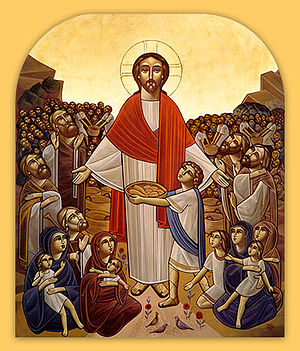
            The miracle of the loaves and fishes looks beyond a one-time feeding of a crowd in Galilee to the sustenance that Jesus will offer to the Church throughout the ages.  This is evident in both the disciples' role and in Jesus' actions.  The disciples are aware of the crowds' need for food and so they suggest to Jesus, “This is a deserted place and it is already late.  Dismiss the crowds so that they may go to the villages and buy some food for themselves.”  But Jesus does not want to disperse the crowd and therefore he tells the disciples, “There is no need for them to disperse.  Give them something to eat yourselves.”  Aware of their own paltry resources, the disciples reply, “We have nothing here but five loaves and a couple of fish.”  This is all Jesus needs to feed the crowd.  Through his life giving power, the five loaves and two fish are transformed into superabundant sustenance for the crowd so that "The fragments which remained, when gathered up, filled twelve baskets."  The verbs used by Matthew in describing Jesus' actions would have Eucharistic connotations for Matthew's church and they still do for us. “He took the five loaves and two fish, looked up to heaven, blessed and broke them and gave the loaves to the disciples, who in turn gave them to the people.” When the Church attempts to fulfill its mission on its own human resources, it is powerless. Only in and through Jesus' power, still present in our Eucharistic celebrations, we as his disciples are able to satisfy the hunger of the crowd.    

Monday, July 20, 2020

17TH Sunday A

Christ is the treasure hidden in the field – Catholic World Report


17th Sunday in Ordinary Time A

Readings: 1 Kings 3:5,7‑12  Romans 8:28‑30  Matthew 13:44‑52

            By our very nature we search for the secret of wisdom.  In today's readings God offers us the simple answer to that quest: the gift of the wisdom is to do God's will.  Let us make our own the prayer of the responsorial psalm. “For I love your command/ more than gold, however fine.
For in all your precepts I go forward;/ every false way I hate” (Ps119:127‑128).
            In the reading from 1 Kings young Solomon has just succeeded his father, David, as king of Israel, and God appears to him "in a dream at night," offering him the opportunity to have anything he may want.  “Ask something of me and I will give it to you.”   Rather than requesting the crass material rewards of a long life, riches, or military victory, Solomon has the insight to pray humbly for God's gift of wisdom to rule and judge the chosen people. "O Lord, my God, you have made me, your servant, king to succeed my father David; but I am a mere youth, not knowing at all how to act.  I serve you in the midst of the people whom you have chosen, a people so vast that it cannot be numbered or counted.  Give your servant, therefore, an understanding heart to judge your people and to distinguish right from wrong.  For who is able to govern this vast people of yours?" The Lord is pleased with Solomon's selfless request and promises him the gift of wisdom for which he became renowned. "I give you a heart so wise and understanding that there has never been anyone like you up to now, and after you there will come no one to equal you."
            The second reading continues Paul's lyrical description of the basis for Christian hope in the midst of our lives of "groaning" for the completion of God's kingdom.  Our hope has its foundation in God's providential plan of salvation by bringing those who love him "to share in the image of his Son."   Just as we share in the image of Adam, the selfish and mortal one, so God has called us to be conformed to his Son, the selfless and resurrected one.  Paul uses a series of five overlapping verbs to describe what God has accomplished for us in his providential plan for salvation through his Son.  In Christ, God "foreknew," "marked out in advance," "called," "justified," and "glorified" us.  Paul's language of "election" and "preordaining" should not be understood in the sense that God decrees salvation for some individuals and damnation for others.  Rather, Paul is applying the biblical tradition of election to the Christian community of his time that is made up of both Jews and Gentiles.  This inclusive community is the result of God's plan for salvation for the whole human family.

The Gospel reading continues Matthew's parable chapter with three parables addressed to the disciples about the nature of God's kingdom.  The first two, the treasure in the field and the pearl of great price, proclaim that the kingdom is the most valuable of all realities and that it calls for a single‑minded response.  In the case of the buried treasure in the field, the stress is on the surprise of what is found, not on the man's morality.  “Out of his joy” at stumbling on this treasure, the man hides it again, sells all he has and buys the field.  The joyful discovery that we are called to do God's will is such an experience.  In the pearl of great price, the discovery is the result of a diligent search: the merchant is “seeking” for fine pearls.  But his response is the same as in the first parable.   When he finds “one really valuable pearl,” he too is glad to “put up for sale all that he had” in order to buy it.                       
            The dragnet parable is like the parable of the wheat and weeds from last week's readings.  Although we are responsible for the way we personally respond to the gift of the kingdom, we are not charged with the sorting out “the worthwhile” and “useless” fish in the kingdom.  God has reserved that task for the angels at the end time.  
            Jesus concludes the parable discourse by asking his disciples, “Have you understood all this?”  When they reply, “Yes,” he reminds them of their task and ours: to be scribes, learned in the reign of God, who can bring forth from their  “store(s)” the wisdom of Jesus' “new” teaching as well as “the  old” of the Jewish Torah. 

Monday, July 13, 2020

16th Sunday A


What are parables and why did Jesus use them? --Aleteia16th Sunday of the Year A

Readings: Wisdom 12:13,16‑19  Romans 8:26‑27  Matthew 13:24‑43

            "Lord, you are good and forgiving."  The refrain from this Sunday's responsorial psalm (Ps 86) captures the theme of today's readings.  As we listen to the proclamation of the Lord's mercy, let us hear it as both an invitation to repentance and a call to show mercy ourselves. 
            The first reading from Wisdom is a hymn praising and thanking God for his mercy.  Although God is mighty and just, the author of Wisdom is especially overwhelmed by God's clemency. “But though you are master of might,/ you judge with clemency,/ and with much lenience you govern us;/ for power, whenever you will attends you.”  The lessons of God's mercy are twofold: (1) God's people must mingle justice with kindness and (2) always have hope for repentance. “And you taught your people, by these deeds,/ that those who are just must be kind;/ and you gave your sons good ground for hope/ that you would permit repentance for their sins.”
            The second reading continues chapter 8 of Paul's letter to the Romans with an explanation of how the Spirit helps Christians pray while groaning inwardly in "weakness" as they await the completion of God's kingdom begun in Jesus.  Paul understands the Christian community as the first fruits of the harvest of God's kingdom.  Through Jesus' triumphant death and resurrection, we Christians have been given the gift of God's renewing Spirit which "makes intercession for us with groanings which cannot be expressed in speech."  Although we may not even know how to articulate the deepest needs of our hearts, "He who searches hearts knows what the Spirit means, for the Spirit intercedes for the saints as God himself wills."

            The Gospel reading continues Matthew's great parable chapter from last Sunday's readings with three more parables: the weeds and the wheat, the mustard seed, and the yeast.  In order to understand the significance of these parables, it is helpful to recall what has preceded this chapter in Matthew.  In chapters 11‑12 Jesus has clearly presented himself to the crowds and leaders as the Messiah, the very Wisdom of God, and has invited them to respond.  Sadly, they have rejected Jesus' claims and have accused him of being possessed by Beelzebul.  Now Jesus speaks to his opponents in "parables" which "announce what has lain hidden since the creation of the world," but they do not understand them because their minds and hearts are closed to Jesus' message. 
            Despite this depressing and potentially violent situation, Jesus' parables are filled with hope.  Both the mustard seed and the yeast parables contrast the small, even insignificant, beginnings of "the reign of God" with its triumphant growth and outcome.  The mustard seed “is the smallest seed of all, yet when full‑grown it is the largest of plants.”  The image of the birds of the sky building their nests in its branches connotes a traditional image of the triumph of God's kingdom (see Ezek 17:23; 31:6; Dan 4:7‑9,17‑19).  Likewise a little yeast is infinitesimally small in comparison with “three measures of flour,” yet when a woman kneads it into the dough, “the whole mass of dough began to rise.”
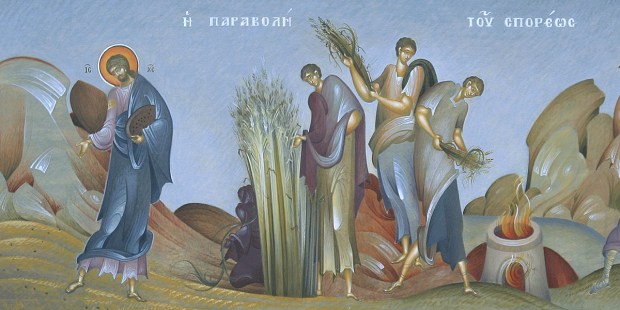
            Although the weeds and wheat parable also ends with the  hopeful image of a harvest in which the wheat is gathered into the barn, it makes another point for those who would like to  immediately eliminate all opposition to the kingdom.   This attitude is perfectly expressed in the speech of the owner's slaves who ask their master, “Do you what us to go out and pull them (the weeds) up?”  The patience of the master in the parable is the same as that of Jesus in his ministry. Rather than responding violently to those who have rejected him, Jesus exercises patience in the hope that they may change.  He also extends this lesson to his disciples who might be tempted to hasten the reign of God by sorting out the good and the bad.  The master answers his slaves:    "No, pull up the weeds and you might take the wheat along with them.  Let them grow together until harvest; then at harvest time I will order the harvesters, first collect the weeds and bundle them up to burn then gather the wheat into my barn." In Jesus' allegorical interpretation of the parable we learn that the judgment will take place at the end of time and it will be the work of the Son of Man and his angels.  This frees us, Jesus' followers, from the task of sorting out who are the saints and who are the evil ones.  That will be the Son of Man's job at the end; we are free to be about the more productive work of extending the kingdom by proclaiming God's mercy and inviting people to repentance.

Monday, July 6, 2020

15th Sunday A

I hate "The Parable of the Sower"! — The King's Centre

<iframe width="560" height="315" src="https://www.youtube.com/embed/0En0of7sWSI" frameborder="0" allow="accelerometer; autoplay; encrypted-media; gyroscope; picture-in-picture" allowfullscreen></iframe>

15th Sunday in Ordinary Time A

Readings: Isaiah 55:10‑11  Romans 8:18‑23  Matthew 13:1‑23

            "The seed that falls on good ground will yield a fruitful harvest."  As the response to the psalm proclaims, this Sunday's readings are both promise and challenge.  We are assured of the fulfillment of God's word in a fruitful harvest, but we are also questioned about whether we have been receptive ground for that life‑giving word.
            The Isaiah reading is part of a hymn of joy and triumph which concludes Second Isaiah's prophecy announcing the good news of Israel's return from Babylonian exile.  Despite the apparent  hopelessness of the exiles' situation in Babylon, the prophet  assures them that God's word has decreed their return and will bear fruit as inevitably as "the rain and snow" do not return to  the heavens "till they have watered the earth,/ and made it  fertile and fruitful. . .".  Just as in nature "the one who sows" and "the one who eats" are dependent upon the rain from heaven, so Israel must learn to trust that God's word will accomplish his saving purpose. “It (my word) shall not return to me void,/ but shall do my will,/ achieving the end for which I sent it” (Isa 55:11).         
            The Romans reading continues Paul's lyrical description of the saving effects of Jesus' death and resurrection for both the Christian community and the whole of creation.  Using the Jewish apocalyptic tradition that a period of great suffering and turmoil would precede the completion of God's kingdom, Paul assures his fellow Christians: "I consider the sufferings of the present to be as nothing compared with the glory to be revealed in us."  Because of Adam's sin "Creation was made subject to futility," but "not without hope."  It "will be freed from its slavery to corruption and share in the glorious freedom of the children of God."  In the present order, however, "creation groans and is in agony even until now."  We Christians also "groan inwardly while we await the redemption of our bodies."  But this common fate of "groaning" is not without hope.   "We have the Spirit as the first fruits" of the harvest of God's kingdom.
            Matthew's parable of the sower also affirms the triumph of God's kingdom despite opposition from both outside and within the Christian community.  Matthew draws a sharp contrast between the crowds who refuse to accept the mystery of God's kingdom (see the preceding chapters 11‑12) and Jesus' disciples who are open to it.  After Jesus has spoken the parable, his disciples ask him, "Why do you speak to them in parables?"  He answers that the reason the kingdom of God is hidden from his opponents is their own hardness of heart—“seeing they do not see, and hearing they do not hear, nor do they understand.”  In them the terrifying prophecy of Isaiah has been fulfilled.  In contrast, the disciples are the “blessed” who are witnessing and hearing what “many prophets and righteous longed to see.”

            Jesus' allegorical interpretation of the parable warns the disciples, and us, of the various ways they and we too may reject the kingdom, but ends with an assurance of its eventual triumph.  Some disciples, like the seed along the path, “hear the message about God's reign without understanding it.”   Like the birds eating the seed along the path, “the evil one” steals away “what was sown in the mind.”  Others, like the seed upon the rock, hear the message with joy for a while, but because they have no root, last only for a time and falter in times of persecution and trial.  Still others, like the seed choked by briars, allow worldly anxiety and the lure of money to choke off the seed.   Despite these failures, God's word does find good soil: those “who hear the message and take it in.” Let us pray that we may be that receptive soil.