Monday, September 25, 2023

26th Sunday of the Year A

Eugene Burnand

 26th Sunday of the Year A

Readings: Ezekiel 18:25‑28   Philippians 2:1‑11  

 Matthew 21:28‑32


            A central doctrine of both Judaism and Christianity is that God's mercy calls sinners to repentance.  Both religions reject a fatalism that would say people are predetermined in their conduct, and, instead, take the hope-filled position that God's mercy always makes it possible for the sinner to freely turn from a life of sin and find the new life God offers.  The correlative truth, however, is that the good person may turn from virtue and life to iniquity and death.  As we struggle in freedom to embrace God's mercy, let us pray in the words of the responsorial psalm:

                        Your ways, O Lord, make known to me;/ 

                        teach me your paths,/

                        guide me in your truth and teach me,/

                        for you are God my savior. (Ps 125:4‑5)

            In the Ezekiel reading, the prophet is instructing the Israelites who are complaining that “the Lord's way is not fair!”   They are enduring twin tragedies: the destruction of Jerusalem and the exile to Babylon, and many, believing that these punishments are due not to their own sins but those of their forefathers, are complaining: ‘Fathers have eaten green grapes,/ but their children's teeth are on edge.’  In response to this complaint Ezekiel insists on both God's mercy and justice and the corresponding freedom and responsibility of each Israelite.  On the one hand, if a virtuous person turns to sin, death will result.   But, on the other, if a wicked person rejects sin and does what is right and just, "he shall surely live, he shall not die."  The virtuous are to persevere, and the wicked are to repent.

            The second reading continues the selections from Philippians with Paul's magnificent hymn to Christ who triumphed over sin through self‑emptying love.  In the context of exhorting the Philippians to give up selfish and petty jealousy, Paul uses this early Christian hymn as the foundation for the Christian life of selfless love.  The pattern, established in Jesus, of death to self and resurrection through God's power is to mark the life of the community.  Christ, in contrast to his anti-type Adam, did not grasp at being godlike, but, like the suffering servant in Second Isaiah, took the form of a slave and emptied himself by becoming fully human, even to the point of obediently accepting the degradation of death on a cross.  God responded to this act of self emptying love by exalting Jesus and bestowing on him lordship over the cosmos, so that at the mention of his name all beings in the universe might acknowledge him as Lord and Messiah.


            Jesus' parable about the two sons is addressed to the chief priests and elders who are challenging his authority for cleansing the Temple.  This bitter controversy will lead to their decision to arrest and execute him.  After they had questioned him about his authority to drive the money changers out of the Temple, Jesus responded by asking them whether John's baptism was “from God” or “from human origin.”  Jesus’ challenge exposes their hypocrisy.  For, if they say, “from God,” Jesus would ask why they had not believed in John's call to repentance, and, if they say, “of human origin,” they fear the crowd who revered John as a prophet. Caught in their hypocritical web, they refuse to answer.

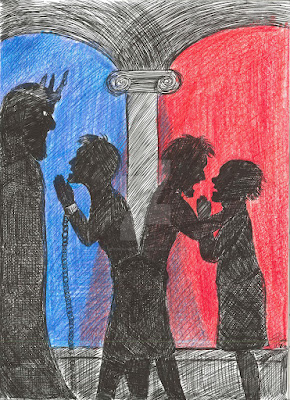
            Now Jesus challenges the chief priests and elders to repent by asking them to judge the case he proposes in the parable.  A father has two sons.  When the first son is asked to work in his vineyard, he says, “I am on my way, sir;” but he never went.  On the other hand, the second son initially refuses to obey his father's command, but “afterward (he) regretted it and went.” Jesus then asks the leaders, “Which of the two did what the father wanted?”  After they answer, “the second,” Jesus uses the parable to contrast their response to John's preaching with that of the "tax collectors and prostitutes."  The later, like the second son, repented of their sins when they heard John's preaching and thereby “are entering the kingdom of God.”  The leaders, however, like the first son, claim to be willing to do the father's will, but “put no faith” in John's preaching, even after they saw the repentance of the tax collectors and prostitutes.   Their smug religiosity keeps them from true repentance and belief in God's call through John's preaching. 

God's call is both challenge and offer of mercy.  If we have said "yes" to God, we must always ask, "Have I followed through in deeds?"  If we have rejected God in the past, we must remember His mercy always offers the opportunity for repentance and change.

Monday, September 18, 2023

25th Sunday of the Year A


 25th Sunday of the Year A

Readings: Isaiah 55:6‑9  Philippians 1:20‑24,27  Matthew 20:1‑16


            "For my thoughts are not your thoughts,

            nor are your ways my ways, says the Lord." (Isa 55:8)


            In our relationship with God, we may be tempted to calculate our standing on the basis of human conceptions of justice.  Today's readings challenge us to accept the surprising ways of God's mercy.   Let us be open to God's mercy to others, as we sing our responsorial psalm: "The Lord is near to all who call him" (Ps 145).

The first reading from the concluding poems of Second Isaiah is an invitation to the wicked to repent.  It is modeled on a priestly invitation to come to the sanctuary for sacrifice, but Second Isaiah makes this appeal in exile where the Jews have no sanctuary.  The prophet stresses two important features of God's call.  First, it comes at certain propitious moments: "Seek the Lord while he may be found,/ call to him while he is near."    Second, God "is generous in forgiving," and his mercy is beyond all human reckoning.

                        As high as the heavens are above the earth,

                        so high are my ways above your ways

                        and my thoughts above your thoughts.

            For the next four Sundays our second reading will be from Paul's letter to the Philippians.   As is evident from today's reading, Paul writes this letter while he is in prison and awaiting trial for preaching the gospel.  He is not sure whether he will be condemned to die or be released so that he may continue his apostolic work, but he sees advantages in both possibilities: "I long to be freed from this life and to be with Christ, for that is the far better thing; yet it is more urgent that I remain alive for your sakes."  Paul's faith tells him that the outcome is in God's hands and that in either case "Christ will be exalted" by bringing forth "life" from a situation which, to human eyes, is fraught with death. 

                        For, to me, "life" means Christ; hence dying is so

                         much gain.  If, on the other hand, I am to go on living

                        in the flesh, that means productive toil for me . . .

            The Gospel parable is traditionally called "The Laborers in the Vineyard," but it might be better entitled "The Generous Vineyard Owner."  Jesus' story gives us a glimpse of both God's generosity and the revolutionary character of "the reign of God."   The "owner" and "vineyard" are traditional images, drawn from the prophets (see Isaiah 5 and Jeremiah 12), for God and Israel.

            In the first half of the parable, the owner, apparently anxious to complete his grape harvest, hires workers at "dawn," "mid-morning," "noon," "mid-afternoon," and finally "late afternoon."  Concerning the workers hired at dawn, we learn that the owner "reached an agreement with them for the usual daily wage."   So far, the parable, with its anxious vineyard owner and unemployed day laborers, seems to be a typical picture of agrarian life in the time of Jesus. 


            In the second half of the parable, however, we, and those who had "worked a full day in the scorching heart," are shocked by the owner's actions.  For some unstated reason, he instructs his foreman, "Call the workmen and give them their pay, but begin with the last group and end with the first."   Then, in defiance of any profit driven business practice, he gives those hired at the last hour “a full day's pay.”  Naturally, the full day workers, having endured the indignity of being paid last, “supposed they would get more,” but they too “received the same daily wage.”

            The dialogue between the disgruntled all day workers and the owner contains the punch line of the parable.  Understandably, the full day workers are upset at the apparent injustice of their being paid the same wage for twelve hours of work as those who only worked an hour.  But the master of the vineyard reminds them, “My friend, I do you no injustice.  You agreed on the usual wage, did you not?  Take your pay and go home.”  Then the owner goes on to give an explanation for his behavior.  “I intend to give this man who was hired last the same pay as you.  I am free to do as I please with my money, am I not?  Or are you envious because I am generous?”  God's generosity is not calculable on a human scale of "good business" or justice, and, in fact, often strikes the dutiful as injustice.  In Jesus' own ministry, he was often criticized by the religious leaders for his association with "tax collectors and sinners."  Within Matthew's community, there was concern about the entrance of Gentiles into an originally Jewish Christian community.  To all those who would put limits upon those called to "the reign of God," Jesus says, "`I am free to do as I please with my money, am I not?  Or are you envious because I am generous.' Thus the last shall be first and the first shall be last."

Monday, September 11, 2023

24th Sunday of the Year A

Devin Quigley


 24th Sunday of the Year A

Readings: Sirach 27:30‑28:7  Romans 14:7‑9 

 Matthew 18:21‑35 


            Forgiveness of those who have wronged us may be one of the most difficult teachings of the Jewish and Christian traditions, but in today's readings we learn that it is absolutely essential if we are to truly experience the God of Moses and Jesus.  Conscious of our own need for forgiveness and the necessity of extending forgiveness to others, let us gratefully sing this Sunday's responsorial psalm: "The Lord is kind and merciful/ slow to anger, and rich in compassion" (Ps 103).

            The wisdom sayings of the Book of Sirach remind us that Jesus’ teaching on forgiveness of the enemy is a continuation of his own Jewish tradition. Sirach's reflections about the destructive nature of wrath and anger are rooted in his understanding of the nature of the covenant God of Israel.  In mercy the Most High has entered a covenant with Israel and overlooked its faults, and as a consequence the children of Israel are to set aside vengeance and to forgive one another.  They cannot directly repay God for his forgiveness; only if they extend forgiveness to others, do they properly understand the demands of God's covenant love.

                        Forgive your neighbor's injustice; 

                        then when you pray, your own sins will be forgiven. 

                        Should a man nourish anger against his fellows 

                        and expect healing from the Lord? 

                        Should a man refuse mercy to his fellows, 

                        yet seek pardon for his own sins? 

            Paul's reflections in the Romans reading come in the midst of a chapter in which he is urging two factions in the community to be considerate and non‑judgmental of one another.  The "weak in faith" (possibly Jewish‑Christians) are keeping certain dietary restrictions and observing special days (the Sabbath?), but others are eating whatever they want and consider every day alike.  In both cases, the individuals are acting in sincerity "for the Lord."  Therefore, Paul urges both groups to leave judgment to the Lord.  The basis for this attitude is that Christians are no longer their own masters.  They belong to the Lord, to Christ who died and came to life again for them.  They are to live and die as his responsible servants, and each of them will have to give an account before the judgment seat of God.


                        For if we live, we live for the Lord, and if we die, we die for the Lord; so then, whether we live or die, we are the Lord's.  For this is why Christ died and 

came to life, that he might be Lord of both the dead 

and the living.  Why then do you judge your brother

Or you, why do you look down on your brother?  For we shall all stand before the judgment seat of God; . . . 


            The Gospel reading continues the theme of forgiveness with the unforgettable story of the unforgiving servant.  The context for Jesus' parable is the conclusion of the discourse in Matthew 18 on relations among Christians.  Peter tries to force Jesus to make a legal determination of how often one must extend forgiveness to a brother who has wronged him.  Peter's initial proposal of forgiving “seven times” seems quite generous, but Jesus replies that forgiveness should be unlimited.  “No, not seven times; I say, seventy times seven times.” 


            He then proceeds to illustrate the folly and tragedy of not being forgiving with a parable about the “reign of God.”  The behavior of the king in the parable is surprising.  At first when he discovers that one of his officials owes him 10,000 talents (a huge sum equivalent to billions of dollars in our currency), he orders that the official be “sold, along with his wife, children, and all his property.”  But, when the official begs, “My lord, be patient with me and I will pay you back in full,” the king is moved with pity, releases the official, and writes off the debt. 

            The next scene mirrors the first with, of course, significant differences.  When the same official, having just been forgiven a huge debt, goes out, he meets a fellow servant who owes him 100 denarii, a debt that could reasonably be repaid.  But when his fellow servant asks for patience in the same words as the official had, “Be patient with me, and I will pay you back,” the official refuses and has his fellow servant put in jail until he pays back what he owed.  When the master hears of the official's callous behavior, he confronts him with his lack of compassion:

“You worthless wretch!  I canceled your entire debt      

when you pleaded with me.  Should you not have dealt 

                        mercifully with your fellow servant, as I dealt with you?”

Jesus ends his parable by warning, “My heavenly Father will treat you in exactly the same way unless each of you forgives his brother from his heart.”

Monday, September 4, 2023

23rd Sunday of the Year A


 23rd Sunday of the Year A  

Readings: Ezekiel 33:7‑9   Romans 13:8‑10   Matthew 18:15‑20 


            In this Sunday's liturgy both the Ezekiel reading and the Gospel challenge us to correct those within the community who have sinned.  But in the second reading we are also reminded that the only debt we owe to anyone is love them.  As we strive to be faithful to both the demands of God's justice and the command to love one another, let us humbly listen to the call of this Sunday's responsorial psalm: "If today you hear his voice,/  harden not your hearts" (Ps 95).  

            The first reading is part of Ezekiel's commissioning as a prophet (see also Ezekiel 3).  He is living with the Jewish exiles in Babylon, and the Lord calls him to be the "watchman for the house of Israel."  Like the sentry who alerts a city when an invading army is approaching, Ezekiel has the all important responsibility of warning the wicked that they will die if they do not repent of their sins.  If Ezekiel does not speak out, God will hold him responsible for their death.  If he does warn them, then, even if they refuse to listen, he will save himself.   

            The reading from Romans continues the exhortation section of that letter with Paul's summary of Christian ethical responsibilities.  Like Jesus, Paul believes that the command, "You shall love your neighbor as yourself," fulfills or includes all the individual commandments that have to do with the neighbor: the prohibitions of adultery, murder, theft, and coveting.  Paul understands the obligation to love the neighbor as a "debt" owed to the neighbor because of what God has done for us in forgiving our sins through the death and resurrection of Christ.  Love is not some vague emotional feeling for the neighbor, but an active and considerate concern "that never does any wrong to the neighbor" (see also 1 Corinthians 13).  

            The Gospel reading is taken from Jesus' fourth great discourse in Matthew which is addressed to Peter and the other disciples and treats relationships in the community.   In this section Jesus is giving advice on how to settle disputes if one member of the community wrongs another.  Jesus proposes four stages for the settling of such problems.  First, if one has been wronged, the person should point out the fault to the other and attempt to keep the matter between the two of them.  If the other party listens, you have won that person over (see Lev 19:17, 18).  If this method fails, one should bring forward another witness in accord with the prescriptions of the Jewish law (see Deut 19:15).  If the person fails to listen to the witnesses, then the matter should be referred to the church (the individual community).  Finally, if the person ignores the church, then the community should treat the offender as "a Gentile or tax collector."   This does not mean that the person is permanently expelled from the community.  Recall that Jesus himself frequently associated with Gentiles, tax collectors and sinners and called them to conversion (Matt 8:5‑13; 9:9‑13; 11:19; etc.).  


            After giving a procedure for settling disputes, Jesus confers upon the community the authority to make decisions in disciplinary matters.  "I assure you, whatever you declare bound  on earth shall be held bound in heaven, and whatever you declare  loosed on earth shall be held loosed in heaven" (see also Matt  16:19).  Jesus' final words move beyond the realm of disputes to prayer.  He ends with the consoling promise of his continued presence within the community when it gathers for prayer in his name (see also Matt 28:20). 

                                    "Again I tell you, if two of you join your voices on earth  

                                    to pray for anything whatever, it shall be granted you by  

                                    my Father in heaven. Where two or three are gathered in  

                                    my name, there am I in their midst."

Monday, August 28, 2023

22nd Sunday of the Year A


 22nd Sunday of the Year A

Readings: Jeremiah 20:7‑9  Romans 12:1‑2  

Matthew 16:21‑27 


            In last Sunday's Gospel Jesus blessed Simon as the Rock (petros) of the church for confessing him as the Messiah and the Son of the living God.  But in this week's Gospel Jesus has to condemn Peter as "Satan" and a "stumbling stone" (skandalon) for failing to accept the necessity of the Messiah's suffering and death on his way to resurrection and glory.  As we learn of the need for Jesus' disciples to also embrace the way of self- denial and the cross, let us cry out to God for help with the refrain of this Sunday's responsorial psalm: "My soul is thirsting for you, O Lord my God" (Ps 63).

            In the first reading the prophet Jeremiah is struggling with the suffering that his mission has caused him.  In bold language, he accuses God of "seducing" him into speaking a message of "violence and outrage" to the sinful people of Judah and Jerusalem.  He then laments bitterly that his fidelity to God's word has brought him only "derision and reproach all the day."   Despite his aversion to his prophetic mission, Jeremiah admits that he cannot escape it.  Although he has repeatedly decided to "speak in God's name no more," Jeremiah must inevitably succumb to the power of God's word.    

                                    But then it becomes like fire burning in my heart,  imprisoned in my bones;  I grow weary holding it in,  I cannot endure it. 


            In the Romans reading Paul is beginning the section of the letter which exhorts his readers to live the ethical demands of the Christian life.  He adapts cultic language to describe what is expected of the Roman Christians in their new lives.  Although they do not offer animal sacrifices to God as  was done in the Jewish temple, Paul urges the Roman converts "to  offer (their) bodies as a living sacrifice holy and acceptable to  God . . ."  Paul believes that Jesus' death and resurrection have  begun the new age expected by the Jews.  Christians, therefore, cannot "conform" themselves to the old sinful age but must be "transformed" so that they "judge what is God's will, what is good, pleasing and perfect." 

            After Peter's confession of Jesus as the Messiah which we heard in last Sunday's Gospel (Matt 16:13‑20), Jesus begins to unveil a whole new dimension to his mission: the necessity for his suffering and death in Jerusalem at the hands of the religious leaders.  Peter, apparently still full of self-importance over the lofty title and blessings given to him, attempts to correct Jesus with the words: "May you be spared, Master! God forbid that any such thing ever happen to you!"

            In attempting to dissuade Jesus from his mission, Peter is performing the same function as Satan in the temptation scenes (Matt 4:1‑11).  Therefore, Jesus must reprimand him in the most severe language. 

                   "Get out of my sight, you satan!

                                    You are a stumbling block to me. 

                                    You are not judging by God's standards but by man's." 

Jesus then goes on to insist that not only are the cross and death necessary for him as the Messiah, but they will also be the path for his disciples who follow him.

"If one wishes to come after me, he must deny

   his very self, take up his cross, and begin to 

                                    follow in my footsteps. 

As he journeys to his own cross, Jesus offers his would be followers a paradoxical, yet priceless, wisdom.

                                    "Whoever would save his life will lose it, 

                                    but whoever loses his life for my sake will find it." 

To spend one's life in attempting to gain the whole world, as Satan had suggested in his temptations (Matt 4:1‑11), will only lead to self destruction.

                                    "What profit would a man show if he were to gain the 

                                    whole world and ruin himself in the process? 

                                    What can a man offer in exchange for his very self?"

Monday, August 21, 2023

21st Sunday in Ordinary Time A


 21st Sunday in Ordinary Time A

Readings: Isaiah 22:15, 19‑23  Romans 11:33‑36  

Matthew 16:13‑20 


            This Sunday's liturgy celebrates Simon Peter's confession of faith  in Jesus as "the Messiah, the Son of the living God" and Jesus'  promise to Simon Bar Jonah that he will become the "Rock" (petros) upon whom Jesus will build his Church.  Let us pray for the Lord's continued guidance of his Church in the words of the responsorial psalm: "Lord, your love is eternal/ do not forsake the work of your hands" (Ps 138).

            The Isaiah oracle provides the background for some of the symbolic language used in Jesus' promise to Simon Peter in the gospel.    In the Lord's name, Isaiah announces that Shebna will be "thrust"  from his station as "master of the palace" in the Davidic court  because he has abused the office  by hewing for himself a pretentious tomb and glorying in his chariots (Isa 22:15‑18).  In his place the Lord will "summon" the faithful Eliakim, son of  Hilkiah, whom he will invest with the symbols of office as  "master of the palace" for "the House of David." 

                        I will place the key of the House of David on his shoulder; 

                                    when he opens, no one shall shut, 

                                    when he shuts, no one shall open. 

                                    I will fix him like a peg in a sure spot, 

                                    to be a place of honor for his family.   

The handing over of "the key of the House of David" is the symbol used in Jesus' conferral of authority upon Simon Peter.  It may have been part of the investiture ceremony for "the master of the palace;" it symbolizes full control over the royal family and palace.

            The second reading is the conclusion of Paul's long reflection on the place of Israel and the Gentiles in God's plan of salvation (Romans 9‑11).  Paul has agonized over the fact that the majority of his fellow Israelites have not accepted Jesus as the Messiah, but he has concluded that the gifts and call of God to Israel are irrevocable and that their temporary rejection of  the gospel has been an opportunity for the Gentiles to "be grafted onto" the "rich root of the olive tree" (Israel). Paul ends with a song of praise, quoting from Isaiah and Job in humble acknowledgment of the mystery of God's plan for salvation.

                                    How deep are the riches and the wisdom and knowledge of God! 

                                    How inscrutable his judgments, how unsearchable his ways! 

                                    "For who has known the mind of the Lord? 

                                    Or who has been his counselor?" 

                                    "Or who has given him anything 

                                    that he may be repaid?"           


 Matthew’s account of Simon Peter’s confession of Jesus as “the Messiah, the Son of the living God” is the climax of this portion of his Gospel.  In response to Peter’s confession, Jesus in turn establishes Simon as Peter (the Rock) of his church.  In the previous chapters the Pharisees and scribes from Jerusalem have repeatedly rejected Jesus’ claims to be the very incarnation of God’s wisdom through his teachings and actions proclaiming the kingdom of God (chapters 11-15), and he in turn has condemned them as hypocritical “blind” guides who close the kingdom to those who would enter (see also chapter  23).   Jesus has also warned Peter and the other disciples to “beware of the leaven (i.e. the teaching) of the Pharisees and Sadducees” (16:5-12)

Now, after journeying north to the region of Caesarea Phillipi, Jesus asks his disciples: “Who do people say the Son of Man is?”  They reply with the various opinions of the populace: John the Baptist (come back to life), Elijah, Jeremiah, or one of the prophets.  When Jesus asks them their belief, Peter, in contrast to the disbelieving leaders and with a fuller understanding than the crowd, confesses: “You are the Messiah, the Son of the living God.” As a disciple of faith, Peter is not one of the wise and learned from whom the kingdom is hidden (see Matt 11:25), but one of the blessed childlike to whom the Father can reveal the Son (Matt 11:25-29).  Therefore, Jesus responds by blessing him: “Blessed are you, Simon son of Jonah, for flesh and blood has not revealed this to you, but my heavenly Father.”

Jesus then gives Simon the title “rock” upon which he will build his church, and he promises it protection from the power of evil.  Jesus also gives Peter responsibility for teaching and leadership in his church which will replace the failed teaching office of the Pharisees and scribes.

“And I say to you, you are Peter,

and upon this rock I will build my church,

and the gates of the netherworld shall not prevail against it.

I will give you the keys to the kingdom of heaven.

Whatever you bind on earth shall be bound in heaven;

and whatever you loose on earth shall be loosed in heaven.”

Peter is established as the vice-regent in the royal household of Jesus’ kingdom.  He is given “the keys to the kingdom” so as to open it to all by teaching faithfully what Jesus has taught in the gospel.  At the end of the Gospel the risen Jesus will send his disciples to the nations with this mission.

“All power in heaven and on earth has been given to me.

Go, therefore, and make disciples of all nations,

baptizing them in the name of the Father, and of the Son, and of the Holy Spirit, teaching them to observe all that I have commanded you.

And behold, I am with you always, until the end of the age.”

Monday, August 14, 2023

20th Sunday in Ordinary Time A


 20th Sunday in Ordinary Time A

Readings: Isaiah 56:1,6‑7 Romans 11:13‑15, 29‑32  

Matthew 15:21‑28


            All religious traditions, including Christianity, can lapse into legalistic exclusivity.  Today's readings challenge us with the message that God's plan for salvation includes all peoples:  both the Jews and the Gentiles (all other nations).  Let us pray in the words of the responsorial psalm: "May the peoples praise you, O God;/ may all the peoples praise you!" (Ps 67:6).

            The Isaiah reading is addressed to the Jewish community that has returned from exile and is in the process of restoring the temple destroyed by the Babylonians.  In this time of reconstituting a worshiping community, arguments arose over requirements for membership.  Some, like the prophet Ezekiel, opposed the admission of foreigners who were "uncircumcized in both heart and flesh" (see Ezek 44:4‑9).  In contrast, the anonymous prophet of this Isaiah passage instructs the returning exiles in God's name that righteous foreigners belong in the worshiping community.   God's salvation and justice are about to come, and the only important requirement is: to "observe what is right, do what is just."  Foreigners, who are willing to "keep the Sabbath free from profanation" and "hold to (the Lord's) covenant," are to be welcomed in the restored temple.

                        Them I will bring to my holy mountain

                        and make joyful in my house of prayer;

                        their holocausts and sacrifices

                        will be acceptable on my altar,

                        for my house shall be called

                        a house of prayer for all peoples.

            In Romans Paul continues to struggle with the place of his Jewish people in God's plan for salvation through Jesus the Messiah.  In this section he is warning the Gentiles that, although most Jews have not accepted Jesus as the Messiah, this does not mean that the Gentiles are the new chosen people.  The Gentiles are, in Paul's metaphor, a "wild olive shoot," grafted  on to Israel, "the rich olive tree" (Rom 11:17‑24).  If the Jews’ temporary rejection of Jesus has meant reconciliation for the world (the Gentiles), then their acceptance will mean "nothing less than life from the dead!".   "God's gifts and his call (to the Jews) are irrevocable."  Both Gentiles and Jews are saved by moving from disobedience to an acceptance of God's mercy.  For centuries the Gentiles were disobedient because they did not know the Torah, but now they have received mercy at this time when many Jews are disobedient to God's plan for salvation through Christ.  In the future Jewish disobedience will also be turned to mercy because, according to Paul, "God has imprisoned all in disobedience that he might have mercy on all."


            In Matthew's tension filled story a foreign Canaanite woman makes a bold demand that Jesus heal her possessed daughter and thereby initiates a new stage of Jesus' mission which begins to envision the inclusion of Gentiles.  Surprisingly, this pagan woman addresses Jesus with titles that indicate a deep faith.   She cries out, “Lord, Son of David, have pity on me!  My daughter is terribly troubled by a demon.”  But she receives a harsh rejection.  Jesus gives "her no word of response," and his disciples entreat him: “Get rid of her.  She keeps shouting after us.”  At this point Jesus gives some explanation for his behavior by saying, “My mission is only to the lost sheep of the house of Israel.”  The woman refuses to accept Jesus answer, and Matthew tells us, "She came forward then and did him homage with the plea, 'Help me, Lord!'"   Jesus goes on to use a proverb to defend the idea that he must confine his work to Israel: “It is not right to take the food of sons and daughters (the Jews) and throw it to the dogs (the Gentiles).”  Not to be outdone in proverbial wisdom, the persistent woman replies, “Please, Lord, even the dogs eat the leavings that fall from their masters' tables.”  Impressed by the woman's wisdom and overwhelmed by her faith, Jesus concludes, “Woman, you have great faith.  Your wish will come to pass.”   Matthew concludes, "That very moment her daughter got better."  

            The Canaanite woman's faith and wisdom stand in sharp contrast to the legalism of the religious leaders and the obtuseness of the disciples in the previous incident in Matthew (see 15:1‑20). The scribes and Pharisees from Jerusalem make the ritual cleanliness laws of their elders more important than God's commands to honor the parents, and the disciples fail to  understand that it is not what goes into a person from the  outside that defiles, but rather the evil intentions that come from the heart: “murder, adultery, fornication, theft, perjury  and slander.”