Monday, August 29, 2022

23rd Sunday in Ordinary Time C


23rd Sunday in Ordinary Time C

Readings: Wisdom 9:13‑18  Philemon 9‑10,12‑17   

Luke 14:25‑33


Our capitalist culture advocates elaborate financial planning with the promise that the right "package" will guarantee us future security.  Today's readings debase all such human calculations and offer in their stead a wisdom which challenges us to be prepared to renounce all distractions for the sake of following Jesus.   Let us pray to the Lord for this wisdom in the words of the psalm: "Teach us to number our days aright/ that we may gain wisdom of heart" (Ps 90:12). 

The first reading from the Book of Wisdom puts on Solomon's lips a prayer for the gift of wisdom to govern the people of Israel.  This section contrasts the limited perspective of humans with God's mysterious plans.  "For who knows God's counsel,/ or who can conceive what the Lord intends?" (Wis 9:13).  We who are burdened with a "corruptible body" can scarcely "guess the things on earth," to say nothing of searching out "things in heaven."   But all is not hopeless.  God gives the gift of wisdom and sends the "holy spirit from on high" to those humble enough to ask for it.  When we have this wisdom, our path on earth is "made straight."

In his moving letter to Philemon Paul is asking that Philemon receive Onesimus, his runaway slave whom Paul converted in prison, as a full brother in Christ.  Paul's petition is filled with passionate language designed to move Philemon to accede to this request and possibly even allow Onesimus to return to Paul in prison.  He describes Onesimus as "my child whom I have begotten during my imprisonment" and reminds Philemon: "I am sending my heart!"  Paul was so fond of Onesimus that he considered keeping him to serve his needs in prison, but then he decided to return him to Philemon "so that kindness might not be forced on you but freely bestowed."  Paul goes on to suggest that Onesimus was separated from Philemon for the purpose "that you might possess him forever, no longer as a slave but as more than a slave, a beloved brother . . ."   In the Christian community the deep social division between slave and master has been obliterated so that Paul can conclude by telling Philemon, "If  then you regard me as a partner (in the gospel), welcome him as  you would me."

In the Gospel Luke presents sayings of Jesus which challenge "a great crowd" to steadfast discipleship.  Following Jesus must be more important than family, self, or possessions.  The twin parables of the tower builder and the king contemplating a battle emphasize wise planning. In worldly affairs, people weigh the costs before a serious undertaking because they do not want to appear foolish when they are not able to complete it.  No man wants to begin building a tower only to run out of money and become a laughingstock "because he began to build what he could not finish."  A king going to battle considers if his forces are adequate, and if not, sues for peace "while the enemy is still at a distance."   Likewise, Jesus' would be disciples must realize that in face of persecution and worldly allurements the cost of discipleship is very high.  Worldly attachments must be jettisoned.  Jesus concludes by saying, "Likewise, none of you can be my disciple if he does not renounce all his possessions."

Monday, August 22, 2022

22nd Sunday in Ordinary Time C

 God Exults the Humble — Mount Carmel Place of Prayer

22nd Sunday in Ordinary Time C


Readings: Sirach 3:17‑18, 20, 28‑29  Hebrews 12:18‑19, 22‑24  

Luke 14:1,7‑14 


"God in your goodness, you have made a home for the poor."   The refrain for this Sunday's psalm (Ps 68) reminds us that God's kingdom challenges and subverts the worldly values of prestige, power, wealth, and physical perfection.  As followers of Jesus, we are called to imitate God who "gives a home to the forsaken" and "leads forth prisoners to prosperity" (Ps 68:7).

The reading from the Book of Sirach is a series of sayings exhorting us to be humble and give alms.  Such a life is not based on a shrewd calculation of how to succeed in the world but on a truthful acknowledgment of how we stand before God.  In a line omitted from our reading we are reminded, "For great is the power of God;/ by the humble he is glorified" (Sir  3:19).  Recognition of our utter dependence upon God's graciousness frees us from a frantic searching "into things beyond (our) strength" and makes us generous sharers of our wealth through the giving of alms.

The second reading completes the selections from Hebrews with a striking contrast between the assembly gathered on Mount Sinai to seal the old covenant and "the assembly of the first‑born enrolled in heaven" to partake in the new covenant mediated by Jesus' blood.  As the author of Hebrews loves to do, the old covenant is understood as frightening, inaccessible, and incomplete.  Sinai is described as "an untouchable mountain" with "a blazing fire, and gloomy darkness and storm and trumpet blast."  The Israelites were terrified when they heard God's voice speaking words, and "they begged that they be not addressed to them."  In contrast, Christian believers are reminded that they have drawn near to an assembly which joyfully experiences the very presence of God.   The heavenly assembly is described as "Mount Zion," "the city of the living God," "the heavenly Jerusalem," filled with "myriads of angels in festal gathering."  Although they are still pilgrims in this world, Christian believers have already approached "God the judge of all," "the spirits of the just made perfect," and "Jesus, the mediator of a new covenant."

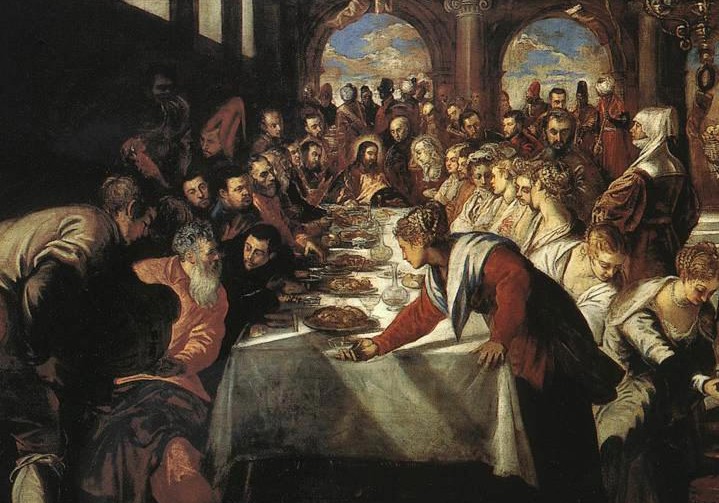
In the Gospel from Luke Jesus uses the occasion of a Sabbath  meal in the home of a leading Pharisee to challenge the protocol and hypocritical pecking order of aristocratic society.  To the guests, who are pushing and shoving to get the places of honor at the table, Jesus commands “go and sit in the lowest place” less they be embarrassed when “some greater dignitary” arrives and they must shamefacedly give up their seat of honor and go and sit  in the lowest place.  Jesus' humorous example of an embarrassing reversal of seats at a banquet is more than a piece of worldly table etiquette.  He is shocking the guests into realizing that God's rule subverts their own deeply ingrained social standards, and therefore he concludes by saying, “For everyone who exalts himself shall be humbled, and he who humbles himself shall be exalted.”


Jesus' admonition to the host is even more shocking.  Rather than invite as guests wealthy relatives and friends who will  return the favor, the host is commanded to invite beggars and the  disabled, the very ones excluded from aristocratic society and Temple worship (see Lev 21:16‑23). 

In the parable which follows today's reading (Lk 14:15‑24),  Jesus goes on to describe the messianic banquet as a feast where the rich invited guests exclude themselves by failing to accept the invitation.  They are replaced by the poor and disabled when the angry master orders his servant, “Go out quickly into the streets and alleys of the town and bring in here the poor and the crippled, the blind and the lame.”  When there is still room, he commands his servant, “Go out to the highways and hedgerows and make people come in that my home may be filled.” Those of us who assume that God values our standards of power, wealth and physical perfection would do well to listen to the master's harsh rejection of the wealthy invited guests: ". . . I tell you none of those men who were invited will taste my dinner."

Monday, August 15, 2022

21st Sunday in Ordinary Time C


Stream Strive to Enter Through the Narrow Gate - 21st Sunday in OT by  Slaking Thirsts | Listen online for free on SoundCloud 

21st Sunday in Ordinary Time C


Readings: Isaiah 66:18‑21  Hebrews 12:5‑7,11‑13  Luke 13:22‑30


We are all capable of being narrow and parochial in our religious attitudes toward "outsiders."  This Sunday's readings challenge us to be open to the universality of God's plan for salvation.  Let us take to heart the lyrics of our psalm: "Praise the Lord, all you nations;/ glorify him, all you peoples" (Ps  117:1).

Our first reading is from the conclusion of the entire book of the prophet Isaiah.  It is taken from the portion that scholars call Third Isaiah which was probably written in the late sixth century B.C. after the Jewish exiles had returned to Jerusalem as they were rebuilding the temple. This prophet, in contrast to some of his elitist fellow Judeans, announces that after the purification of Jerusalem, Jewish survivors will be sent by God to the nations and distant coastlands to proclaim his glory to those who "have never heard of (God's) fame."  In God's name, the prophet proclaims: “They shall bring all your brethren from all the nations as an offering to the Lord/ . . . to Jerusalem, my holy mountain, says the Lord,/ just as the Israelites bring their offering to the house of the Lord in clean vessels.” He even dares to announce in God's name: "Some of these I will take as priests and Levites, says the Lord."

The reading from Hebrews continues directly from last week's section in which Jesus, who endured the cross, is presented to us as our model for persevering "in running the race" of faith.   Using a quotation from Proverbs 3:11‑12, the author reminds us that the Lord disciplines those whom he loves.  The trials we meet in being faithful Christians should be understood as the loving discipline of our Father.  In the language of the Hellenistic philosophy of the day, the author uses an athletic metaphor to conclude his exhortation.  “Make straight the paths you walk on, that your halting limbs may not be dislocated but healed."

In the Gospel from Luke Jesus continues his journey to Jerusalem and warns the crowds that entrance into the messianic banquet is difficult.  Someone in the crowd asks, "Lord, are they few in number who are to be saved?"  Rather than answer directly, Jesus responds with a series of parabolic warnings, using the image of the door.  First of all he replies, “Try to come in through the narrow door.  Many, I tell you will try to enter and be unable.”  Then, changing the door image, he warns that some may be too late in responding to the call of the kingdom. "When once the master of the house has risen to lock the door and you stand outside knocking and saying, ‘Sir, open for us,' he will say in reply, `I do not know where you come from.'  Then you will begin to say, ‘We ate and drank in your company. You taught in our streets.'  But he will answer, ‘I tell you, I do not know where you come from.  Away from me you evildoers!'"


Entrance into the messianic banquet calls for a radical change of heart; mere social contact with Jesus is not enough.

Finally, Jesus warns the crowd that they may be rejected from the final messianic feast and replaced by the Gentiles.“And there will be wailing and grinding of teeth when you see Abraham, Isaac and Jacob and all the prophets in the kingdom of God and you yourselves cast out. People will come from the east and the west, from the north and the south, and will take their  place at the feast in the kingdom of God.” Jesus concludes by asserting that God's kingdom overturns our worldly standards: “Some who are last will be first and some who are first will be last.”

Monday, August 8, 2022

20th Sunday in Ordinary Time C

 Jeremiah 38: Jeremiah Thrown Into a Cistern

20th Sunday in Ordinary Time C


Readings: Jeremiah 38:4‑6,8‑10  Hebrews 12:1‑4  Luke 12:49‑53


            Every four years the Olympic Games captivate us with stories of athletes who have disciplined and trained themselves for years in order to win medals in competition with the best in the world.   In today's readings Jeremiah and Jesus give us inspiring examples of unwavering and passionate commitment to God's word, even to the point of death.  Only those who trust God in faith will be able to follow their heroic example.  Let each of us pray in the words of this Sunday's psalm:

                        Lord, come to my aid!

                        Though I am afflicted and poor,

                        yet the Lord thinks of me.

                        You are my help and my deliverer;

                        O my God, hold not back!  Ps 40:18

            In his call to be a prophet (Jeremiah 1), Jeremiah learned that he would have to stand like "a fortified city, a pillar of iron, a wall of brass, against the whole land."  His beloved Judah would have to die before it could live again.  Therefore, Jeremiah was summoned to speak God's word which would first "root up and tear down . . . destroy and demolish" and only then "build and plant" a purified nation.  

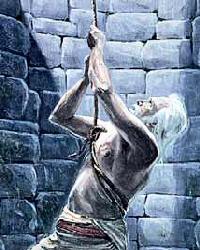
            In today's reading we hear an example of how Jeremiah lived out his call even to the point of death, only to be rescued by the courageous action of Ebed‑melech, a Cushite courtier in the king's palace.  Jerusalem is under siege from the Babylonian armies, and Jeremiah is imprisoned in quarters of the guard for his preaching.  While there, he has counseled the Judean soldiers to cease defending the doomed city and to desert to Babylonians in order to save their lives (Jer 34:2‑3).  Understandably, the princes view Jeremiah's words as treason and report to king Zedekiah, “Jeremiah ought to be put to death; he demoralizes the soldiers who are left in this city, and all the people by speaking such things to them; he is not interested in the welfare of our people, but in their ruin.”   Ironically, the prophet is deeply concerned with the spiritual welfare of the nation, and his advice to desert will guarantee that some will survive the destruction of the city.  Jeremiah's seemingly unpatriotic advice earns him what amounts to a death sentence.  Zedekiah allows the princes to throw him in a muddy cistern where he would surely die of starvation.  But God's plans for Jeremiah are not finished. He is rescued by Ebed‑melech and will go on to survive the destruction of the city and preach of the Lord's restoration of Judah and Jerusalem after a long exile (see Jeremiah 30‑33). 

            The Hebrews reading continues the theme of suffering for the sake of God's word by using the metaphor of an athletic contest, like the ancient Olympics, to exhort us to follow Jesus "who inspires and perfects our faith."  Last week's reading from Hebrews 11 presented "a cloud of witnesses" from the Old Testament who lived lives of faith in patient endurance.  Now they stand on the sidelines cheering us on as we "lay aside every encumbrance of sin which clings to us and persevere in running the race which lies ahead."  To succeed in this race, we must "keep our eyes fixed on Jesus," who "for the sake of the joy which lay before him . . . endured the cross, heedless of its shame."   The fact that he, like Jeremiah, "endured the opposition of sinners" and still triumphed at "the throne of God" should encourage us not to "grow despondent or abandon the struggle."


The passionate intensity of Jesus' words to his disciples in the Gospel makes sense only when we realize the he is on his way to Jerusalem where he is destined to "suffer greatly and be rejected by the elders, the chief priests, and the scribes, and be killed and on the third day be raised" (Lk 9:22; see also 9:44; 13:31‑33).  In the context of warning the  disciples about their need to be vigilant and faithful servants once he has departed (recall last week's gospel), Jesus speaks in anguish about his own approaching fate as a "baptism" of  fire which he wishes were already set ablaze.   When Jesus was first presented in the Temple as a child, Simeon had prophesied about him to his mother Mary:

                        "Behold, this child is destined for the fall

                        and rise of many in Israel, and to be a sign

                        that will be contradicted . . . so that the

                        thoughts of many hearts may be revealed." (Lk 2:33‑34)

Now Jesus himself tells the disciples that his mission is not one of peace based on complacency but division which will sort out those who are willing to accept God's will from those who would compromise it. 

                        "Do you think I have come to establish peace      

                        on the earth?  I assure you the contrary is true;

                        I have come for division!"  (Lk 12:51)

Monday, August 1, 2022

19th Sunday in Ordinary Time C

 What Is an Apostle? Definition in the Bible

19th Sunday in Ordinary Time C


Readings: Wisdom 18:6‑9  Hebrew 11:1‑2,8‑19  Luke 12:32‑48


In our cynical and secular culture faith is a rare virtue.   This Sunday's readings challenge us to be people of faith who live in trust that God's future will bring deliverance from evil and gifts beyond our imagining.  Let us place our confidence in the Lord's fidelity to his promises, as we sing the lyrics of this Sunday's psalm:

See the eyes of the Lord are upon those who fear him,

upon those who hope for his kindness,

To deliver them from death

                        and preserve them in spite of famine.  (Ps 33:18‑19) 

The reading from the book of Wisdom is a poem describing the faith of our Jewish ancestors on the night of the Passover when they were delivered from Egyptian bondage.  That night they courageously put their faith in God's oaths promising deliverance, as they awaited "the salvation of the just and the destruction of their foes."  Their faith was expressed by offering the Passover sacrifice, "putting into effect with one accord the divine institution."  This same faith in awaiting the Lord's deliverance from evil should mark our Christian Eucharistic celebrations.

The second reading is taken from the great encomium on the faith of our Jewish ancestors in Hebrews.  It begins with a formal definition: "Faith is confident assurance concerning what we hope for, and conviction about things we do not see."  Through faith we attain what we hope for, and faith is the virtue by which we are put in touch with the unseen realities of God so that we may attain things unseen in the present. 

Each of the examples begins with the phrase, "by faith," and they, in some way, anticipate the resurrection faith of Christians. Abraham's faith enabled him to obey God's call to go forth to the land he was to receive as a heritage "without knowing where he was going."  His faith also gave him the hope "to live as an alien in the promised land as a foreign country."   "He," like Christian believers, "was looking forward to the city with foundations, whose designer and maker is God."  Sarah's faith gave her the "power to conceive though she was past the age, for she thought that the One who made the promise was worthy of trust."  Her faith, like that of Christians, was in God's power to bring life from the dead.  

As a result of (Sarah's) faith, there came forth

from one man, who was himself as good as dead,

descendants as numerous as the stars in the sky

                        and the sand of the seashore. 

Finally, Abraham's faith in being willing to sacrifice his son Isaac was also an anticipation of resurrection faith because "He reasoned that God was able to raise from the dead, and so he received Isaac back as a symbol." 


The Gospel from Luke continues the theme of the future orientation of Christian faith which calls for Jesus' disciples to live in trust and fidelity as they await the completion of God's kingdom.  In this section of the journey to Jerusalem, Jesus is teaching his followers that their faith should free them from earthly anxiety and make them faithful in performing their duties.  Because the Father has given them the kingdom, the disciples are free to sell their possessions and give alms.  Jesus commands them, “Get purses for yourselves that do not ware out, a never‑failing treasure with the Lord which no thief comes near nor any moth destroys.”  Jesus tells the disciples to be like servants “awaiting their master's return from a wedding, so that when he arrives and knocks, you may open for him without delay.”  If they are prepared, the master himself “will put on an apron, seat them at table and proceed to wait on them.”  Then Jesus uses the parable of the thief breaking into a house to illustrate that the time of his return in unknown.  When Peter asks if this parable is meant for the disciples, Jesus answers by telling them to be “faithful, farsighted steward(s)” who are “busy” doing their duties, rather than the type of servant who counts on his master's delay and abuses his fellow servants.  Ascertaining the time of the Lord's return is inadequate motivation for faithful behavior. 

Monday, July 25, 2022

18th Sunday in Ordinary Time C

 55. Parable of the Rich Fool (Luke 12:13-21)

18th Sunday in Ordinary Time C


Readings: Ecclesiastes 1:2; 2:21‑23 Colossians 3:1‑5,9‑11  

Luke 12:13‑21


Today's readings present a shocking challenge to the very foundation of our capitalist society which values a person simply on the basis of financial worth.  As we are reminded of the folly of spending our lives in the accumulation of wealth, let us take to heart the refrain of our responsorial psalm, "If today you hear his voice, harden not your hearts" (Ps 95).

Ecclesiastes, or Qoheleth, is a wisdom meditation on the "vanity of vanities," or complete emptiness, of all human striving which would fashion a meaning out of life apart from God.   Perhaps the ultimate example of such vanity is the man who uses his all "wisdom and knowledge and skill" to acquire property which he must leave to another.  Qoheleth even uses the language of business to remind us of the futility of such a life.   "For what profit comes to a man from all the toil and anxiety of heart with which he has labored under the sun?"  When we add up the ledger sheet, we discover that he has gained nothing but days filled with "sorrow and grief" and nights when "his mind is not at rest."  Qoheleth appropriately concludes, "This also is vanity." 

In contrast to the futility of Qoheleth's meditations, the Epistle offers a hopeful and transcendent vision of life based on belief in the resurrected Christ.  Paul is exhorting the Colossians to live out the consequences of their baptism.   "Since," in baptism they "have been raised up in company with Christ," they are now to set their hearts "on what pertains to the higher realms . . . rather than on the things of earth."   Their ultimate destiny is to "appear" with Christ "in glory."   In the meantime, baptism mandates that they "put to death" the earthly life of "fornication, uncleanness, passion, evil desires, covetousness . . ."   Their new life is to "be formed anew in the image of the Creator."  In the new creation wrought by the resurrected Christ all human categories of status and division have been eliminated. "There is no Greek or Jew here, circumcised or uncircumcised, foreigner, Scythian, slave, or freeman.  Rather Christ is everything in all of you." 

The Gospel returns to the favorite Lukan theme of the vanity of trying to find security through the accumulation of material possessions.  Jesus is asked by someone in the crowd to act as an arbiter in a property dispute.  He rejects such a role and instead proceeds to warn the crowd of the danger of greed through the parable of the rich fool.  The insidious character of wealth is best illustrated by the rich man's soliloquy.  After he has a particularly abundant harvest, he thinks that he has a plan to provide lasting security and the license to pursue a life of luxury.  He says to himself,

‘What shall I do?  I have no place to store my harvest.

I know . . . I will pull down my grain bins and build

larger ones.  All my grain and my goods will go there.

Then I will say to myself: You have blessings in reserve

for years to come.  Relax!  Eat heartily, drink well. 

Enjoy yourself.’ 


In contrast to the rich fool's carefully crafted plans, God says: “You fool!  This very night your life shall be required of you.  To whom will all this piled‑up wealth of yours go?” 

In the next section of Luke Jesus gives his disciples advice on the proper use of their material wealth.

"Sell what you have and give alms.  Get purses for

yourselves that do not wear out, never‑failing

treasure with the Lord which no thief comes near

nor any moth destroys.  Wherever your treasure lies,

there your heart will be." (Lk 12:33‑34)

Monday, July 18, 2022

17th Sunday in Ordinary Time C

Arguing Abraham | Psychology Today

 17th Sunday in Ordinary Time C


Readings: Genesis 18:20‑32 Colossians 2:12‑14  Luke 11:1‑13


This Sunday's readings present graphic examples of the power of prayer.  Let us approach our merciful God with reverence and confidence, as we sing this Sunday's psalm: "Lord, on the day I called for help, you answered me" (Ps 138).  

In the Genesis reading the Lord allows Abraham to boldly bargain for the salvation of Sodom and Gomorrah, two notoriously sinful cities.   In the previous section, the Lord deliberates about telling Abraham his intentions: “Shall I hide from Abraham what I am about to do, now that he is to become a great and populous nation, and all the nations of the earth are to find blessing in him? . . .”  Because of Abraham's role in the divine plan, the Lord allows the patriarch to hear of his intention to investigate “the outcry against Sodom and Gomorrah.”

Then the Lord said: "The outcry against Sodom and

Gomorrah is so great, and their sin so grave, I must

                               go down and see whether or not their actions fully

                               correspond to the cry against them that comes to me.

                               I mean to find out.” 

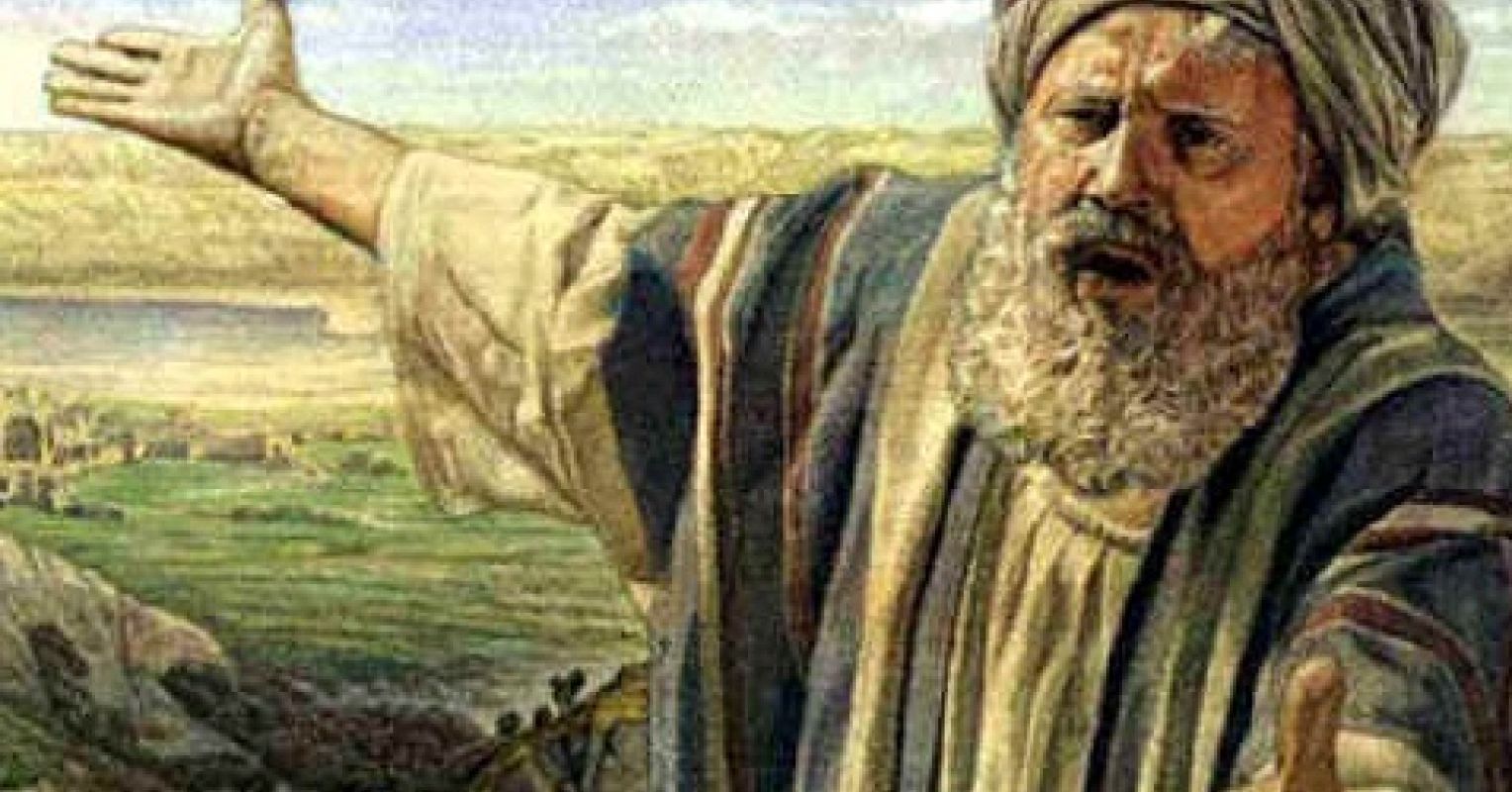
Assuming that a guilty verdict is inevitable, Abraham begs the Lord to spare the cities for the sake of the few innocents who may be in them.  Significantly, he does not simply ask that God spare the innocent, like the family of his nephew Lot (see Genesis 13‑14, 19), but that the whole city be preserved because of the few righteous.  Abraham intercedes with God for pagan sinners, and his argument is quite clever.  He first asks the Lord, “Will you sweep away the innocent with the guilty?”  Presumably, the Lord would answer, “No.” But before he can respond, Abraham rushes on to add, “Suppose there were fifty innocent people in the city; would you wipe out the place, rather than spare it for the fifty-innocent people within it? . . .”   Now Abraham has forced the Lord to agree to spare the whole city if he is to preserve his reputation as “the judge of all the earth” who would not “make the innocent die with the guilty.” Abraham's almost Promethean boldness in pushing God to the point of promising to spare the city for the sake of ten innocent is a lesson to all of us to be courageous in voicing our concerns for justice and mercy to God.

In the second reading Paul continues his attack on those false teachers who want to introduce "circumcision" and certain exotic ascetical and religious practices into the Christian life at Colossae (see 2:16‑23).  In contrast to the fragmented religiosity of his opponents, Paul presents the simple, straightforward truth that in baptism the Christian was buried with Christ and raised to a new life with him.  God does not have some hidden debt against the past sins of a Christian which must be paid by strange penitential practices.  Paul asserts:

He (Christ) pardoned all our sins.  He canceled

the bond that stood against us with all its claims,

snatching it up and nailing it to the cross.


The importance of prayer for the disciples is a theme that occurs repeatedly in Luke's Gospel.  He, more than any other  evangelist, presents Jesus himself as one who prays at important  events in the Gospel: at his baptism (3:21), when he withdraws  into the desert (5:16), when he calls the twelve to the mountain  (6:12), when he begins to teach his disciples about his passion (9:18), at the transfiguration (9:28‑29), at the Last Supper when  he tells Simon of his denial (22:32), in Gethsemane (22:44), and at his crucifixion as he forgives his executioners and commends his spirit to his Father (23:34,46).

In today's Gospel, Jesus' prayer is the occasion for the disciples' request, “Lord, teach us to pray, as John taught his disciples.”  Jesus goes on to teach them the “Our Father” in a more shortened form than in Matthew (6:9‑13) and instructs them to be confident in their prayer through the twin parables of the friend at midnight and the father who gives good gifts to his children.  The argument in both is from the lesser to the greater.  If a friend will rouse himself and his whole house because you come at midnight seeking bread for your guests, how much more will the heavenly Father respond when we pray to him?  And, if we, who are evil, give good things to our children when they ask, then “how much more will the heavenly Father give the Holy Spirit to those who ask him?”   Such teaching should give us the confidence to approach the Father with all of our needs.