Hearing the Word

Monday, September 6, 2021

24th Sunday B


Get Behind Me Satan | Disciples | Torah Portions


24th Sunday in Ordinary Time B

Readings: Isaiah 50:4-9. James 2:14-18  Mark 8:27-35

“Get behind me, Satan. You are thinking not as God does, but as human beings do.”

Jesus’ harsh words to Peter in today’s gospel are a sobering reminder that the Christian Gospel does not conform to worldly standards of power and prestige.  Following Jesus leads to resurrected life, but only after we have gone with him to the cross. “Whoever wishes to save his life will lose it, but whoever loses his life for my sake and that of the gospel will save it.”

In the first reading from the servant songs of Second Isaiah, the prophet/servant gives an autobiographical report of his tireless commitment to speaking a rousing word to the “weary” exiles who think that their Lord is powerless to save them from their Babylonian captors.  Because of his confidence that the Lord is his help, the prophet, like Jesus in today’s Gospel, has the courage not to turn back from his mission, even though it involves suffering and rejection. “The Lord is my help,? therefore I am not disgraced;/ I have set my face like flint,/ knowing that I shall not be put to shame.”


The Epistle continues the sections from James and contrasts “lifeless” faith which merely professes belief and active faith which expresses itself in deeds of kindness for those in need.  James’ example is priceless.  “If a brother or sister has nothing to wear and no food for the day,and one of you says to them, “Go in peace, keep warm, and eat well,’ but you do not give them the necessities of the body, what good is it?”  To merely wish well to a person who has neither food nor clothing is worthless.  This is not real faith at all.  James poignantly concludes by saying: “Demonstrate your faith to me without works, and I will demonstrate my faith to you from my works.”

The Gospel for this Sunday is a climactic incident in Mark.  After revealing the kingdom of God in his powerful healing and preaching ministry throughout Galilee and Gentile regions north and west of Judea (Mark 1:14-8:26), Jesus now journeys to Caesarea Philippi and then toward Jerusalem (8:27-10:54).  He also begins to teach the disciples his full identity as the Son of Man who must both suffer rejection and death at the hands of the Jewish leaders and Gentiles in Jerusalem but also be raised up and return as the glorious Son of Man.  Sadly, the twelve consistently refuse to accept Jesus’ mission and the demands of following him to the cross.

Today’s story is set at a village near Caesarea Philippi in the extreme northern reaches of Jewish territory.  In this obscure place, Jesus asks his disciples the climactic question: “Who do people say that I am?”  They reply that the crowds understand him as a prophet in the tradition of John the Baptist and Elijah.  When Jesus puts the same question to his disciples, Peter, on the basis of what he has witnessed in Jesus’ ministry, is prepared to confess that he is more than a prophet and is indeed “the Christ” or “Messiah.”

Jesus’ response to Peter’s confession is consistent with his stance throughout much of the Galilean ministry.  He warns the disciples “to tell no one about him.”   Peter and the disciples cannot fully understand Jesus simply because of the powerful miracles he has performed.  Now for the first time Jesus teaches them “that the Son of Man must suffer greatly, be rejected by the elders and chief priest and scribes, and be killed, and rise after three days.”  Peter refuses to accept such a destiny for the Messiah and is rebuked, in the most shocking terms, as a “Satan” who is judging by human standards rather than those of God.  Jesus follows his rebuke by insisting that willingness to follow him to the point of taking up one’s own cross in self-denial and even loss of life will be determinative to the disciples’ judgment when the Son of Man comes in glory. 

As we continue to read Mark’s account of Jesus’ journey to Jerusalem, let us ask ourselves if we are prepared to accept the Messiah who comes to us in the apparent weakness of the cross.


Posted by Hearing the word at 11:44 AM No comments:
Email ThisBlogThis!Share to XShare to FacebookShare to Pinterest

Monday, August 30, 2021

23rd Sunday B


Jesus heals a deaf mute – The Witness 

23rd Sunday in Ordinary Time B


Readings: Isaiah 35:4-7  James 2:1-15  Mark 7: 31-37


“Did not God choose those who are poor in the eyes of the world to be rich in faith and heirs of the kingdom he promised to those who love him?  (James 2:5).  Today’s readings announce the coming of God’s kingdom, foretold in Isaiah and realized in Jesus, who brings God’s justice for the infirm and oppressed.  As people of faith in God’s kingdom brought by Jesus, we are called to live by a new standard of justice based on God’s special love for the poor.  We pray in the opening verses of our responsorial psalm: “The God of Jacob keeps faith forever,/ secures justice for the oppressed,/ gives food to the hungry./ The Lord sets captives free” (Ps 146:7).

The Old Testament reading from Isaiah is a prophetic commission to announce God’s salvation to a frightened group of returning Jewish exiles. “Say to those whose hearts are frightened:/ Be strong, fear not!/  Here is your God, he comes with vindication;/ with divine recompense he comes to save you.”  In God’s name, the prophet is to promise wondrous healing for the infirm. “Then will the eyes of the blind be opened,/ the ears of the deaf be cleared;/

Then will the lame leap like a stag,/ then the tongue of the dumb will sing.” God’s coming kingdom will also turn the barren deserts of Judah into a delightful garden with “streams” and “rivers,” “pools” and “springs of water.”

The Epistle from James exhorts the Christian to avoid favoritism because it is contrary to faith “in the Lord Jesus Christ glorified.”  James’ example is a stunning illustration of the way that worldly standards conflict with those of the kingdom of God.  In the world, the fashionably dressed, wealthy person invariably receives deferential treatment, while the poor, shabbily clad, is ignored or shoved aside.  But in the Christian assembly, we are not to discriminate in this way because God has consistently chosen the poor “to be rich in faith and heirs of the kingdom.”


In Mark’s Gospel selection Jesus fulfills the prophetic expectations of the Isaiah reading by healing a deaf and dumb man in the Gentile “district of the Ten Cities” but then mysteriously commands secrecy about the action.  For Mark, Jesus is both the powerful, healing Messiah, promised in the prophets, but also the poor, suffering servant, who will not be fully revealed until his cross and resurrection.  In this selection, Jesus responds to the people’s begging for a healing, but he takes the deaf and dumb man “off by himself away from the crowd.”  In the healing itself, Jesus uses physical gestures and his Father’s power as he commands that the deaf man’s ears be opened in fulfillment of Isaiah’s prophecy. “He put his fingers into the man’s ears and, spitting, touched his tongue; then he looked up to heaven and emitted a groan.  He said to him, ‘Ephphatha!’ (that is, “be opened!”) At once the man’s ears were opened; he was freed from the impediment, and began to speak plainly.  But, once he has cured the man, Jesus again enjoins the crowd not to tell anyone.  They, however, are amazed at Jesus and at a certain level realize that he is bringing the long anticipated Messianic age.  They proclaim: “He has done everything well!  He makes the deaf hear and the mute speak!” 

Upon his entrance into Jerusalem, the crowds will again acclaim Jesus as the powerful Messiah (see ch. 11), but later they will be unable to accept him as the poor, crucified Messiah at the crucifixion.  “Those passing by reviled him, shaking their heads and saying, ‘Aha!  You who would destroy the temple and rebuild it in three days, save yourself by coming down from the cross’” (Mk 15:29-30).  As we rejoice in Jesus’ bringing the kingdom to the needy and infirm, we also remember that this same mission will take him to the cross. 

Posted by Hearing the word at 7:10 AM No comments:
Email ThisBlogThis!Share to XShare to FacebookShare to Pinterest

Monday, August 23, 2021

22nd Sunday B


22nd Sunday in Ordinary Time B


GOSPEL OF MARK CHAPTER 10 - 

Readings: Deuteronomy 4:1-2,6-8. James 1:17-18,21-22,27. 

Mark 7:1-8,14-15,21-23


“The one who does justice will live in the presence of the Lord” (Ps 15).  In an age tempted to ignore the basic ethical teachings of our Biblical faith, the readings for this Sunday remind us that the central message of the Jewish covenant and Jesus’ ethical teaching is doing the will of God as expressed in the commandments of the Torah. 

Moses’ sermon in Deuteronomy is addressed to the Israelites who are about to enter the Promised Land.  He reminds them that observance of the Lord’s wise and just commandments determines if they will live and take possession of the land.  If they carefully observe God’s law without adding or subtracting from it, Moses assures Israel that other nations will observe: “This great nation is truly a wise and intelligent people.”

The Epistle is taken from the Letter of James which we will be reading for the next several weeks.  James is a work of moral exhortation, calling Christians living in a decadent Roman Empire to live by the ways of God and reject the ways of the world.

In this week’s lesson, James reminds his readers that the God the Father “wills to bring us to birth with a word spoken in truth so that we may be a kind of first fruits of his creatures.”  The proper response to that word is to humbly welcome it and let it take root within so that one acts upon it.  To simply listen and not act is to deceive oneself.  True religion, undefiled by the ways of the world, is a life of action in caring for the needy in our midst.  “Looking after orphans and widows in their distress and keeping oneself unspotted by the world make for pure worship without stain before our God and Father.”

In the Gospel, the Pharisees and scribes, Jesus’ traditional enemies in Mark, challenge him by questioning why his disciples do not observe the tradition of the ancestors, but instead take food without purifying their hands.  Mark carefully explains to his Gentile audience the Jewish purification rituals originally meant for the priestly class (cf. Leviticus 15), but now applied by the Pharisees to all Jews. 

Jesus’ reaction is swift and to the point.  He accuses the Pharisees and scribes of being hypocrites like those mentioned in the prophet Isaiah’s prophecy.  “This people pay me lip service but their heart is far from me.  Empty is the reverence they do me because they teach as dogmas mere human precepts.’  (Isa 29:13)


In place of an external ritualism which emphasizes merely human laws concerning washings and unclean foods, Jesus proclaims that the only evils which defile a person are those coming from the deep recesses of the human heart (the seat of will and thought in Hebrew psychology).  The list includes actions forbidden by the Ten Commandments. “Hear me, all of you, and try to understand.  Nothing that enters a man from outside can make him impure; that which comes out of him, and only that, constitutes impurity.  Let everyone heed what he hears!  Wicked designs come from the deep recesses of the heart: acts of fornication, theft, murder, adulterous conduct, greed, maliciousness, deceit, sensuality, envy, blasphemy, arrogance, an obtuse spirit.  All these evils come from within and render a man impure.”

At a time when we are reminded daily of dishonesty and corruption at all levels of government and society, today’s readings challenge us to renew our commitment to living simple lives of honesty and justice based on the just decrees of the Lord.

Posted by Hearing the word at 3:15 PM No comments:
Email ThisBlogThis!Share to XShare to FacebookShare to Pinterest

Monday, August 16, 2021

21st Sunday

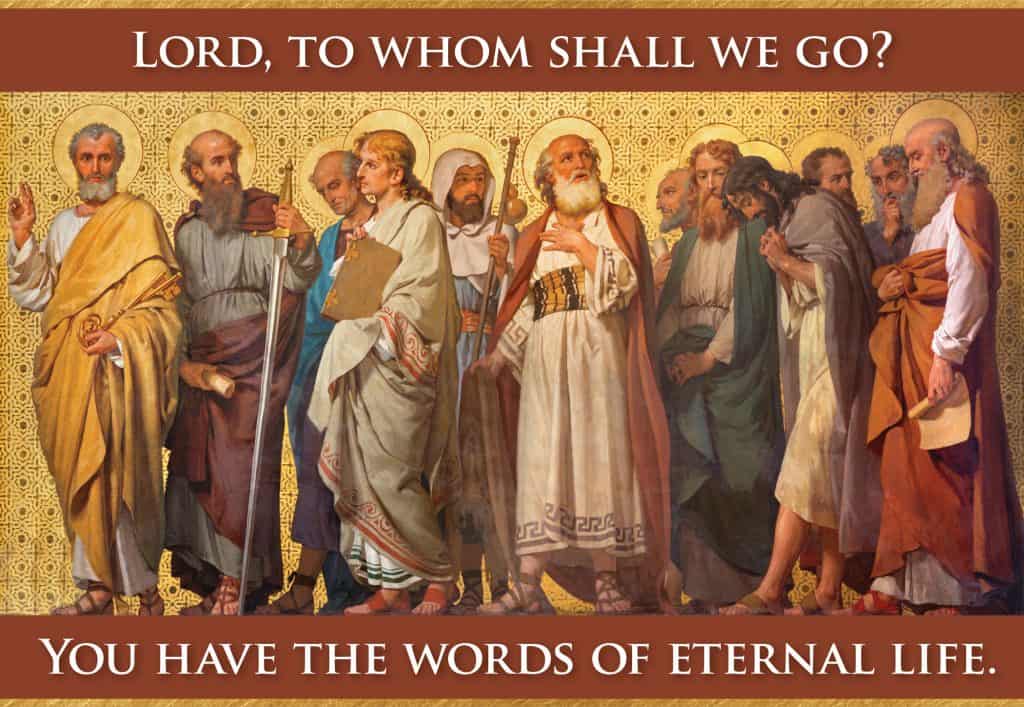
 Tom on Twitter: "Simon Peter answered him, "Lord, to whom shall we go? You  have the words of eternal life; and we have believed, and have come to  know, that you are

21st Sunday in Ordinary Time B


Readings: Joshua 24:1-2,15-17,18  Ephesians 5:21-32  John 6:60-69


As the Church completes its five weeks of reading John’s Bread of Life discourse, we are given a final challenge to choose to go to Jesus, who has “the words of eternal life.”  We are invited to follow the words of the psalmist in today’s responsorial psalm: “Taste and see the goodness of the Lord” (Ps 34).

In the first reading Joshua has just completed the division of the land among Israel’s twelve tribes and now offers the leaders a choice between serving the Lord, who has delivered them from Egypt and given them the land of Canaan, and other gods-- either the ones their “fathers had served beyond the River (the Euphrates)” or “the gods of the Amorites” in whose land they were now living.   For the ancient Israelites this represented a very real choice.  To choose to serve the Lord meant committing to an ethical way of life as delineated in the commandments of the covenant and rejecting the polytheistic animism of their ancestors and the decadent fertility cult of the land of Canaan.  Therefore, covenant with Yahweh was freely entered into by each household.  Joshua speaks as the head of his family when he says, “As for me and my household, we will serve the Lord.”  The assembled people also choose to serve the Lord and give as their reason his gracious saving actions in bringing them out of slavery in Egypt, protecting them along their journey and leading them into the land.

The Epistle completes our reading of Ephesians with an exhortation to “Defer to one another out of reverence for Christ.”  The examples given are taken from a traditional list of household duties that would be found in the philosophical writings of the day.  Homes in the Greco-Roman world of the first century A.D. were structured in a hierarchical manner with the husband/father as head of the household and the wife, children and slaves under his authority.  Ephesians transforms these family obligations by incorporating them into the mystery of Christ’s love for his bride, the Church, and its submission to Christ.  This is best illustrated in the exhortation to husbands to love their wives. “Husbands, love your wives, as Christ loves the Church. He gave himself up for her to make here holy, purifying her in the bath of water by the power of the word, to present to himself a glorious Church, holy and immaculate, without stain or wrinkle or anything of that sort.  Husbands should love their wives as they do their own bodies.  He who loves his wife loves himself. . .”

The Gospel is the conclusion of John’s Bread of Life discourse in which some of the disciples break away from Jesus’ company because of difficulty in accepting his pronouncement: “I myself am the living bread come down from heaven. If anyone eats this bread he shall live forever; the bread I will give is my flesh, for the life of the world.”


Throughout John’s Gospel Jesus’ pronouncements are consistently misunderstood by those who interpret his language without faith, or in a literal or “fleshly” manner.  In this case many of the disciples understand Jesus’ language literally as if he were speaking of cannibalism and remark: “This sort of talk is hard to endure!  How can anyone take it seriously?”  Jesus challenges them to move from a literal/fleshly to a faith-filled/spiritual understanding of his language. “It is the spirit that gives life; the flesh is useless. The words I spoke to you are spirit and life. Yet among you there are some who do not believe.”

When many of the disciples break away, Jesus turns to the Twelve and asks, “do you want to leave me too?”  But Simon Peter, as spokesman for the Twelve and a believer, answers, “Lord, to whom shall we go?  You have the words of eternal life.  We have come to believe; we are convinced that you are God’s holy one.”  Like the Israelites in Joshua’s day and the disciples in John, we are offered a choice: to live lives of faith in gratitude for God’s loving deeds in our behalf or to live the “fleshly” lives of the gods of our time.

Posted by Hearing the word at 6:32 AM No comments:
Email ThisBlogThis!Share to XShare to FacebookShare to Pinterest

Sunday, August 8, 2021

The Assumption of the Blessed Virgin Mary

On the Liturgy and Theology of the Assumption - District of CanadaThe Assumption (August 15)


Readings: Revelation 11:19; 12:1‑6, 10  1 Corinthians 15:20‑26  

Luke 1:39‑56


            The Feast of the Assumption of Mary celebrates our Roman Catholic belief that Mary, "having completed her earthly life, was in body and soul assumed into heavenly glory."  This event is not recorded in the canonical Scriptures, and, therefore, the readings for the feast concentrate on elements related to this belief: Mary's special dignity as the mother of Christ and Christ's victory over sin and death in his resurrection which is the basis for our belief that Mary too, through her son’s resurrection, triumphed over death. 

            The apocalyptic vision in the Revelation reading uses symbols that are common to the myths of the Ancient Near East, Judaism and the Graeco‑Roman world.  All of these traditions have an archetypal story of the heavenly mother and her divine child who is attacked by an evil monster from the sea and then somehow rescued.  In the Book of Revelation this story is used to speak in a symbolic way of Jesus' triumph over the powers of evil through God's raising him to triumph in heaven.  It also alludes to God's protection of the mother and her offspring (faithful Christians).   The "woman clothed with the sun, with the moon under her feet, and a crown of twelve stars on her head" recalls Joseph's dream, where this image symbolizes the tribes of Israel (Genesis 37).   The woman's labor pains are like those of daughter Zion in giving birth to the Messiah, especially in Isaiah 66:7‑9.  It is not surprising that later Christians identified the woman with Mary.   The "huge, flaming red dragon" is a grotesque and bestial personification of the forces of evil.  Despite his terrifying powers, the dragon is not able to devour the "boy who is destined to shepherd all the nations with an iron rod" because he "was snatched up to God and to his throne." The woman is also protected when she flees into the desert, "where a special place had been prepared for her by God."

            In the Corinthians reading Paul is defending the Christian belief in bodily resurrection.  He insists that Christ has been raised from the dead and that he is the first fruits of a harvest which will affect the whole of humanity.  Using the Adam/Christ typology, Paul speaks of Christ as a new Adam who has brought life in place of death.  His resurrection is the first event in an apocalyptic transformation in which the dead will be raised and God's kingdom will be definitively established. “Just as in Adam all die, so in Christ all will come to life again, but each one in proper order: Christ the first fruits and then, at his coming, all those who belong to him.  After that will come the end, when, after having destroyed every sovereignty, authority, and power, he will hand over the kingdom to God the Father.”

            The Gospel is the story of Mary's visiting Elizabeth.  It proclaims the special dignity of Mary in Luke's theology.  Filled with the Holy Spirit, Elizabeth greets Mary with the joyous words, “Blessed are you among women and blessed is the fruit of your womb.”  Mary's exalted status is founded on her trusting faith: “Blessed is she who trusted that the Lord's words to her would be fulfilled.”

            In her canticle, Mary, like Hannah in the Old Testament (1 Sam 2:1‑10), praises God her “savior” who has manifest his power and fulfilled his promises to Abraham by exalting the lowly.  In our celebration of this feast, let us join Mary in singing God's praises. "My being proclaims the greatness of the Lord,/ my spirit finds joy in God my savior,/ For he has looked upon his handmaid in her lowliness;/ all ages to come shall call me blessed. God who is mighty has done great things for me, holy is his name;/ His mercy is from age to age on those who fear him. He has shown might with his arm;/ he has confused the proud in their conceit. He has deposed the mighty from their thrones/ and raised the lowly to high places. The hungry he has given every good thing,/ while the rich he has sent empty away. He has upheld Israel his servant, ever mindful of his mercy;/ Even as he promised our father,/ promised Abraham and his descendants forever." 


Posted by Hearing the word at 3:04 PM No comments:
Email ThisBlogThis!Share to XShare to FacebookShare to Pinterest

Monday, August 2, 2021

19th Sunday B

 Fish Five Loaves Two Photos - Free & Royalty-Free Stock Photos from  Dreamstime

19th Sunday in Ordinary Time B


Readings: 1 Kings 19:4-9  Ephesians 4:30-5:2  John 6:41-51


“Get up and eat, else the journey will be too long for you!”  The angel’s command to Elijah in the first reading challenges us to come to Christ in the Eucharist for the life-giving sustenance we need, especially in times of distress.  Let us pray in the words of the responsorial psalm, “When the afflicted man called out, the Lord heard,/ and from all his distress he saved him. . . . Taste and see how good the Lord is;/ happy the man who takes refuge in him” (Ps 34:6ff).

In the reading from 1 Kings, God’s sustenance transforms Elijah from a frightened man, longing for death, to a resolute prophet, strengthened to resume his God-given mission.  Elijah is fleeing from the wicked queen Jezebel who has put him under a death sentence for defeating and slaying her prophets of Baal on Mount Carmel (see 1 Kings 18:1-19:3).  After a day’s journey into the desert, the prophet comes to a broom tree, sits down, and prays for death as he goes to sleep in hope of never awakening.  Filled with despair by his apparent failure, Elijah is ready to die in the desert, like his forefathers who came out of Egypt and wandered for forty years.  “This is enough, O Lord!  Take my life, for I am no better than my fathers.”  But God has a life-giving mission for him.  Like the frightened Moses before him, he is to journey to Mount Horeb (Sinai), where he will hear in a “tiny whispering sound” telling him he is not alone in his struggle and is to return to his people.  At this point Elijah needs strength for his journey.  Just as the Lord provided his ancestors water and manna in the wilderness, he now sustains his prophet with a hearth cake and jug of water.  Left alone Elijah would die, but strengthened by God’s food and drink, he can journey forty days and nights to the mountain of God.

The second reading continues the selections from Ephesians and presents a series of moral exhortations that illustrate the conduct proper for Christians who have converted from paganism and been baptized (see Eph 4:17-24).  Any action that destroys communal unity (bitterness, passion, anger, harsh words, slander, malice) saddens the Holy Spirit with which the community was sealed (see Eph 2:21-22).  In imitation of the forgiving God and Christ, who “gave himself for us as an offering to God,” Christians are exhorted to “be kind to one another, compassionate and mutually forgiving.”


The Gospel reading continues John’s Bread of Life discourse with Jesus’ challenge to the Jews, who are murmuring like their ancestors in the desert (see Exodus 16; Numbers 11), to believe in him as “the living bread” who gives his flesh for the life of the world.  Because of Jesus’ apparently ordinary human origins, the Jews cannot accept him.  They keep saying, “Is this not Jesus, the son of Joseph?  Do we not know his father and mother?  How can he claim to have come down from heaven?”  In response to these doubts, Jesus insists that only those who are drawn by the Father can come to him, in all his ordinariness, as the revelation of God.  As “the one who is from God and has seen the Father,” Jesus offers both knowledge of the unseen God and a share in God’s eternal life.  He is the fulfillment of the time mentioned by the prophets when “They shall all be taught by God” (see Isa 54:13; Jer 31:33-34).  In contrast to the manna which the ancestors ate in the desert and died, Jesus “is the bread that comes down from heaven, for one to eat and never die.”

Paradoxically, it will be Jesus’ death that will bring this lasting life: “the bread I will give is my flesh, for the life of the world.”  As the Church journeys through Ordinary Time, this Sunday’s readings offer us heavenly food to fend off death’s powers and impel us toward God’s future.  Through the most ordinary of signs--bread broken and eaten in memory of Jesus’ death--we are given the reality of God’s own life of love and are pointed beyond our feeble human powers and aspirations to life eternal.

Posted by Hearing the word at 6:56 AM No comments:
Email ThisBlogThis!Share to XShare to FacebookShare to Pinterest

Monday, July 26, 2021

18th Sunday B


Bread Of Life - John 6:24-40 - Roanoke Valley Church 

18th Sunday in Ordinary Time B


Readings: Exodus 16:2-4,12-15  Ephesians 4:17,20-24  John 6:24-35


The readings for this Sunday proclaim God as the giver of life-sustaining gifts: manna for Israel in its journey through the wilderness, and Jesus, the bread come down from heaven, the source of eternal life.  Christians are challenged to move beyond working simply for perishable food to union with God, the giver of the gifts that sustain God’s people on their journey through history.

The Exodus reading presents a sharp contrast between the grumbling Israelites and the Lord who provides manna and quail for their journey through the wilderness from Egypt to Mount Sinai.  Rather than trusting the God who had saved them from slavery in Egypt with spectacular signs and wonders, “the whole Israelite community” grumbles and wishes nostalgically that they had died in Egypt where “we sat by our fleshpots and ate our fill of bread!”  Material security in slavery is preferred to the freedom of the wilderness which calls for trust in God.  The Israelites complain to Moses and Aaron, “But you had to lead us into this desert to make the whole community die of famine!”  In spite of these rebellious complaints, the Lord patiently promises sustaining gifts of manna and quail “so that you may know that I, the Lord, am your God.”  The purpose of these gifts is not simply physical sustenance in the wilderness.  Behind the Israelites’ complaint about lack of food is their failure to trust in God.  The daily portions of food will be given to “test them to see whether they follow my commandments or not.”  When the Israelites see the strange “fine flakes like hoarfrost” and ask, “What is this (ma-hu’)”? Moses tells them, “This is the bread which the Lord has given you to eat.”  Israel is challenged to move beyond the gift to the giver, the One who sustains the community on its journey to freedom under the covenant.  Sadly, they sin by both trying to store more manna than they need (16:19-21) and then trying to go out to gather manna on the Sabbath when they have provided with a double portion on the day before (16:27-30).

The Epistle reading from the Letter to the Ephesians also exhorts them no longer to live lives of “illusion and desire, and acquire a fresh, spiritual way of thinking.”  This Gentile community that has now been incorporated into the cosmic body of Christ with Jews has to set aside its empty pagan way of life and “put on that new man created in God’s image, whose justice and holiness are born of truth.”

The Gospel is the beginning of the Bread of Life dialogue between Jesus and the crowd that follows his multiplication of the loaves and fishes and the miraculous crossing of the sea by walking on water (John 6:1-21).  As always in John, the dialogues are filled with irony and misunderstanding and challenge Jesus’ hearers to understand those signs as calling for a new spiritual insight into his identity as the One sent from God.


The crowd’s initial question, “Rabbi, when did you come here?” is simply an attempt to find out how Jesus arrived in Capernaum without coming in the boat with his disciples.  But Jesus immediately chides them for looking for him simply because he has physically fed them with loaves and not because they have seen those actions as signs pointing to his relationship with the Father.  He challenges them with wisdom sayings, like Lady Wisdom in Proverbs: “You should not be working for perishable food but for food that remains unto life eternal, food which the Son of Man will give you; it is on him that the has set his seal.”  When they in turn ask what they must do “to perform the works of God,” Jesus replies: “this is the work of God: have faith in the One he sent.”

The dialogue continues to build on the twin themes of “food” and “work.”  When the crowd asks Jesus to perform/work a sign as a basis for their putting faith in him and mentions the sign of manna given to the ancestors to eat in the desert, Jesus’ response is twofold.  First of all, he clarifies that “it was not Moses who gave you bread from the heavens; it is my Father who gives you the real heavenly bread.”  Then Jesus adds that “God’s bread comes down from heaven and gives life to the world,” but the crowd seems to understand him literally.  They want perpetual physical nourishment.  “Sir, give us this bread always.”  With this request, Jesus climactically announces: “I myself am the bread of life. No one who comes to me shall be hungry, no one who believes in me shall thirst again.”  Jesus is proclaiming that belief in him as the revelation of the Father’s love is the way to union with the Father in an eternal life.  “For this is the will of my Father, that everyone who sees the Son and believes in him may have eternal life, and I shall raise him on the last day” (6:40).  Ultimately, this life-giving union with the Father through Jesus is the community’s sustenance as it awaits “the last day.”

Posted by Hearing the word at 9:44 AM No comments:
Email ThisBlogThis!Share to XShare to FacebookShare to Pinterest
Newer Posts Older Posts Home
Subscribe to: Posts (Atom)

Search This Blog

Blog Archive

  • ▼  2024 (40)
    • ▼  August (5)
      • 22nd Sunday in Ordinary Time B
      • 21st Sunday in Ordinary Time B
      • The Assumption (August 15)
      • 20th Sunday in Ordinary Time B
      • 19th Sunday in Ordinary Time B
    • ►  July (5)
    • ►  June (4)
    • ►  May (5)
    • ►  April (5)
    • ►  March (7)
    • ►  February (4)
    • ►  January (5)
  • ►  2023 (61)
    • ►  December (9)
    • ►  November (4)
    • ►  October (7)
    • ►  September (4)
    • ►  August (3)
    • ►  July (6)
    • ►  June (4)
    • ►  May (6)
    • ►  April (5)
    • ►  March (4)
    • ►  February (4)
    • ►  January (5)
  • ►  2022 (60)
    • ►  December (7)
    • ►  November (4)
    • ►  October (6)
    • ►  September (4)
    • ►  August (5)
    • ►  July (4)
    • ►  June (4)
    • ►  May (6)
    • ►  April (7)
    • ►  March (4)
    • ►  February (4)
    • ►  January (5)
  • ►  2021 (59)
    • ►  December (7)
    • ►  November (5)
    • ►  October (4)
    • ►  September (4)
    • ►  August (5)
    • ►  July (4)
    • ►  June (4)
    • ►  May (6)
    • ►  April (4)
    • ►  March (8)
    • ►  February (4)
    • ►  January (4)
  • ►  2020 (55)
    • ►  December (4)
    • ►  November (4)
    • ►  October (4)
    • ►  September (4)
    • ►  August (5)
    • ►  July (4)
    • ►  June (5)
    • ►  May (5)
    • ►  April (7)
    • ►  March (5)
    • ►  February (4)
    • ►  January (4)
  • ►  2019 (56)
    • ►  December (7)
    • ►  November (4)
    • ►  October (4)
    • ►  September (5)
    • ►  August (5)
    • ►  July (5)
    • ►  June (4)
    • ►  May (4)
    • ►  April (5)
    • ►  March (5)
    • ►  February (4)
    • ►  January (4)
  • ►  2018 (63)
    • ►  December (10)
    • ►  November (4)
    • ►  October (5)
    • ►  September (4)
    • ►  August (5)
    • ►  July (5)
    • ►  June (4)
    • ►  May (5)
    • ►  April (5)
    • ►  March (7)
    • ►  February (4)
    • ►  January (5)
  • ►  2017 (59)
    • ►  December (7)
    • ►  November (4)
    • ►  October (5)
    • ►  September (4)
    • ►  August (6)
    • ►  July (4)
    • ►  June (4)
    • ►  May (5)
    • ►  April (7)
    • ►  March (4)
    • ►  February (4)
    • ►  January (5)
  • ►  2016 (51)
    • ►  December (4)
    • ►  November (5)
    • ►  October (4)
    • ►  September (4)
    • ►  August (2)
    • ►  July (5)
    • ►  June (4)
    • ►  May (6)
    • ►  April (4)
    • ►  March (4)
    • ►  February (5)
    • ►  January (4)
  • ►  2015 (60)
    • ►  December (8)
    • ►  November (5)
    • ►  October (4)
    • ►  September (4)
    • ►  August (3)
    • ►  July (6)
    • ►  June (5)
    • ►  May (5)
    • ►  April (8)
    • ►  March (4)
    • ►  February (4)
    • ►  January (4)
  • ►  2014 (61)
    • ►  December (9)
    • ►  November (4)
    • ►  October (4)
    • ►  September (5)
    • ►  August (5)
    • ►  July (4)
    • ►  June (5)
    • ►  May (5)
    • ►  April (7)
    • ►  March (5)
    • ►  February (4)
    • ►  January (4)
  • ►  2013 (64)
    • ►  December (9)
    • ►  November (4)
    • ►  October (4)
    • ►  September (5)
    • ►  August (2)
    • ►  July (7)
    • ►  June (4)
    • ►  May (5)
    • ►  April (5)
    • ►  March (9)
    • ►  February (4)
    • ►  January (6)

About MePatrick V. Reid, PhD Providence College Faculty Resident Director Fall 2012 Patrick V. Re

Hearing the word
View my complete profile
Picture Window theme. Theme images by nicodemos. Powered by Blogger.